Wednesday, August 1, 2018

DXC Technology Co (DXC) Receives $105.38 Average Price Target from Analysts

DXC Technology Co (NYSE:DXC) has received an average rating of “Buy” from the twenty ratings firms that are covering the firm, Marketbeat reports. One research analyst has rated the stock with a sell rating, six have assigned a hold rating, eleven have assigned a buy rating and one has issued a strong buy rating on the company. The average twelve-month price target among analysts that have covered the stock in the last year is $105.38.

DXC has been the subject of a number of recent analyst reports. ValuEngine cut DXC Technology from a “strong-buy” rating to a “buy” rating in a report on Tuesday, April 3rd. JPMorgan Chase & Co. raised their price target on DXC Technology to $114.00 and gave the company an “overweight” rating in a report on Thursday, April 5th. Citigroup raised their price target on DXC Technology to $126.00 and gave the company a “top pick” rating in a report on Thursday, April 12th. Berenberg Bank initiated coverage on DXC Technology in a report on Wednesday, April 18th. They set a “hold” rating and a $100.00 price target for the company. Finally, KeyCorp raised their price target on DXC Technology from $116.00 to $122.00 and gave the company an “overweight” rating in a report on Monday, May 21st.

Get DXC Technology alerts:

In other news, EVP William L. Deckelman, Jr. sold 2,886 shares of the firm’s stock in a transaction on Wednesday, May 16th. The stock was sold at an average price of $100.94, for a total value of $291,312.84. Following the transaction, the executive vice president now directly owns 13,082 shares in the company, valued at approximately $1,320,497.08. The transaction was disclosed in a filing with the Securities & Exchange Commission, which can be accessed through the SEC website. Also, insider John M. Lawrie sold 5,000 shares of the firm’s stock in a transaction on Friday, April 27th. The stock was sold at an average price of $103.04, for a total value of $515,200.00. The disclosure for this sale can be found here. Insiders sold a total of 12,886 shares of company stock worth $1,319,913 over the last quarter. Corporate insiders own 0.65% of the company’s stock.

Several large investors have recently bought and sold shares of DXC. Thrivent Financial For Lutherans grew its holdings in DXC Technology by 5,865.5% during the fourth quarter. Thrivent Financial For Lutherans now owns 11,573 shares of the company’s stock worth $1,098,000 after purchasing an additional 11,379 shares during the period. Advisor Group Inc. boosted its holdings in shares of DXC Technology by 8.3% during the fourth quarter. Advisor Group Inc. now owns 16,367 shares of the company’s stock worth $1,553,000 after acquiring an additional 1,252 shares during the period. Two Sigma Securities LLC bought a new stake in shares of DXC Technology during the fourth quarter worth approximately $225,000. Elkfork Partners LLC bought a new stake in shares of DXC Technology during the fourth quarter worth approximately $11,044,000. Finally, Ladenburg Thalmann Financial Services Inc. boosted its holdings in shares of DXC Technology by 52.5% during the fourth quarter. Ladenburg Thalmann Financial Services Inc. now owns 11,678 shares of the company’s stock worth $1,109,000 after acquiring an additional 4,019 shares during the period. Institutional investors and hedge funds own 83.90% of the company’s stock.

Shares of DXC Technology traded down $0.13, reaching $87.04, during mid-day trading on Friday, according to Marketbeat. The company had a trading volume of 1,795,416 shares, compared to its average volume of 2,295,647. DXC Technology has a twelve month low of $77.26 and a twelve month high of $107.85. The company has a current ratio of 0.98, a quick ratio of 0.98 and a debt-to-equity ratio of 0.46. The stock has a market cap of $24.72 billion, a PE ratio of 10.96, a PEG ratio of 1.35 and a beta of 0.91.

DXC Technology (NYSE:DXC) last released its quarterly earnings results on Thursday, May 24th. The company reported $2.28 earnings per share for the quarter, beating the Zacks’ consensus estimate of $2.22 by $0.06. DXC Technology had a return on equity of 17.74% and a net margin of 7.13%. The firm had revenue of $6.29 billion during the quarter, compared to analysts’ expectations of $6.12 billion. DXC Technology’s quarterly revenue was up 233.2% compared to the same quarter last year. sell-side analysts forecast that DXC Technology will post 8.07 EPS for the current fiscal year.

The company also recently disclosed a quarterly dividend, which was paid on Tuesday, July 17th. Shareholders of record on Wednesday, June 6th were given a $0.19 dividend. This represents a $0.76 dividend on an annualized basis and a yield of 0.87%. This is a positive change from DXC Technology’s previous quarterly dividend of $0.18. The ex-dividend date of this dividend was Tuesday, June 5th. DXC Technology’s dividend payout ratio (DPR) is presently 9.57%.

DXC Technology Company Profile

DXC Technology Company, together with its subsidiaries, provides information technology services and solutions primarily in North America, Europe, Asia, and Australia. It operates through three segments: Global Business Services (GBS), Global Infrastructure Services (GIS), and United States Public Sector (USPS).

Further Reading: Are analyst ratings accurate?

Analyst Recommendations for DXC Technology (NYSE:DXC)

Sunday, July 22, 2018

Merck pledges to cut prices for seven drugs

Merck joined fellow pharmaceutical giants Novartis and Pfizer on Thursday in pledging to limit drug price increases in the United States.

Merck said it's cutting the price of Zepatier, a drug that treats hepatits C, by 60% and reducing the price of six other medications by 10% each.

The company also said it will not raise the average price of the drugs it sells beyond the annual rate of inflation in the United States and will continue to "evaluate our portfolio to look for opportunities to further reduce costs."

The six medications targeted for 10% price cuts are:

�� Prinivil, treats high blood pressure and heart conditions

�� Proscar, treats enlarged prostate

�� Remeron, antidepressant

�� Sinemet, treats symptoms of Parkinson's disease

�� Sinemet (sustained-release)

�� Trusopt, treats symptoms of glaucoma and other eye diseases

The move by Merck (MRK) comes after Pfizer (PFE) announced price hikes for nearly three dozen drugs only to reverse course amid public pressure from President Donald Trump.

Trump in a tweet earlier this month lambasted what he called Pfizer's plans to raise prices "for no reason."

The company announced last week it would halt raising prices on multiple drugs. The company did not, however, roll back price hikes already implemented this year, including on popular medications like Xanax, Lipitor and Chantix.

Swiss firm Novartis followed, pledging not to raise drug prices in the United States this year. The company plans to "evaluate as the environment evolves," Novartis CEO Vas Narasimhan told Bloomberg this week.

The pharmaceutical industry has been the subject of criticism because of climbing drug prices. Trump has promised to pressure the industry to lower drug prices.

However, his administration did little until May, when it rolled out its 44-page "blueprint" for increasing competition, reducing regulations and changing the incentives for all players in the drug industry.

Merck said in a press release Thursday that it has "a long history of responsible drug pricing." Last year, the average net price of all the medications it sells in the United States declined by 1.9%.

�� Charles Riley, Danielle Wiener-Bronner and Tami Luhby contributed to this report.

Thursday, July 19, 2018

Expanded Stock Buyback Parameters for Warren Buffett Could Bring Conflict

Berkshire Hathaway Inc. (NYSE: BRK-A) (NYSE: BRK-B) is not your traditional company. Not by a long shot. The conglomerate run by Warren Buffett and team has two classes of stock and many investors consider it as so diversified that its returns should now simply mirror the stock market or other simple index-performance metrics. That said, this is Buffett’s company and he wants to grow the book value per share for shareholders faster than the overall market.

One issue that can influence any per share calculations (book value, earnings, and so on) is stock buybacks. It turns out that Berkshire Hathaway does have an allowance and formula for repurchasing shares of its own common stock. Up until now, Buffett and his team could repurchase Berkshire Hathaway shares at a price that would not exceed a 20% premium over the current book value of those shares at the time the buybacks occur.

That was then. Now Berkshire Hathaway is creating a new rule for when Warren Buffett and other members inside of the company can repurchase shares of their common stock. Buffett and Charlie Munger have just handed themselves an open checkbook that can be used for buying back stock any time and arguably for any price or reason. A press release on Tuesday evening said:

The Board of Directors of Berkshire Hathaway Inc. has today authorized an amendment to Berkshire��s share repurchase program.� The earlier share repurchase program provided that the price paid for repurchases would not exceed a 20% premium over the then-current book value of such shares.� Under the amendment adopted by the Board of Directors, share repurchases can be made at any time that both Warren Buffett, Berkshire��s Chairman and CEO, and Charlie Munger, a Berkshire Vice Chairman, believe that the repurchase price is below Berkshire��s intrinsic value, conservatively determined.

Let’s think about what this might mean when you break it down. The amendment includes “at any time” and “believe the repurchase price is below Berkshire’s intrinsic value” and “conservatively determined.” The long and short of the matter is that Buffett and Munger only have to publicly say they thought their stock was cheap at any given time.

The good news here for Berkshire Hathaway shareholders is that there are still at least some restrictions placed upon the company that would keep the Buffett-Munger team from going overboard on share repurchases. The company cannot drop under that $20 billion in perceived liquidity by buying back too much stock. The release said:

The current policy whereby share repurchases will not be made if they would reduce the value of Berkshire��s consolidated cash, cash equivalents and U.S. Treasury Bills holdings below $20 billion will continue.� Berkshire will not initiate any share repurchases under the amended program until it publicly releases its second quarter earnings, currently scheduled after the close of the markets on�Friday, August 3, 2018.

Berkshire Hathaway ended 2017 with more than $100 billion between its cash and short-term investments, and it had over $200 billion in long-term investments. Its total assets at year-end tallied up to $702 billion, just over twice as much as its $350 billion in total liabilities. Berkshire Hathaway’s last seen market capitalization, the value at which the equity markets value the company on any given day, was last seen at $472 billion.

Some investors will cheer this news because it will simplify the repurchase criteria to “any day the stock can be justified as cheap, as long as there is $20 billion in the bank.” Other investors will argue that this opens up the company to corporate governance issues wherein management (remember, neither Buffett nor Munger are likely to live forever) has too little control over when it should be buying back stock versus making acquisitions that can grow the company as a whole over time.

ALSO READ: Gold and Precious Metals Moving Toward Lows of the Year

It might be easy to see at least some of the obvious potential conflicts that could arise from this corporate governance change. When you throw in Buffett, it’s easy to assume he would win any argument over what “cheap or value” is on any given day. Then again, Buffett has admitted many times he is not immune from making mistakes.

Berkshire Hathaway’s A-shares closed down $500.00 at $288,500.00 and the B-shares closed down $1.59 at $190.41 on Tuesday. As of Tuesday’s closing bell, the shares were down roughly 4% so far in 2018.

Friday, July 13, 2018

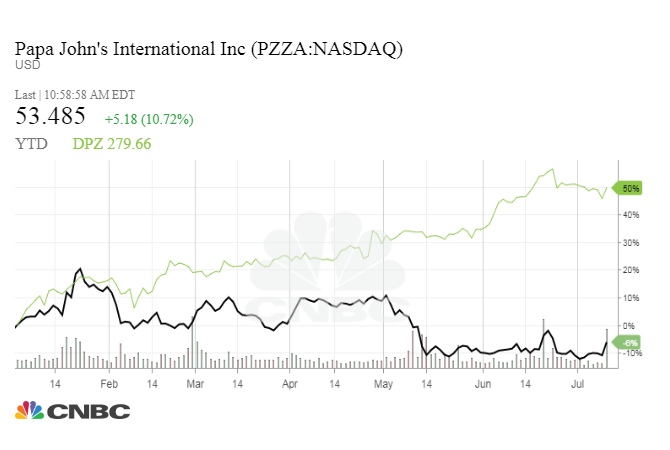
Cramer: Pizza execs say Papa John��s is ��falling apart�� when compared with Domino��s

Papa John��s reputation with executives in the pizza industry has deteriorated after public backlash against its founder, John Schnatter, CNBC's Jim Cramer said Thursday.

"When you talk to high-level people in the pizza industry, there are people who think this company is falling apart," Cramer said on "Squawk on the Street."

Cramer spoke as the restaurant chain's stock was 11 percent higher midmorning Thursday after Schnatter resigned as chairman of the company's board.

The departure came shortly after Schnatter admitted to using the N-word during a May conference call and apologized for the comments after Forbes magazine detailed the incident.

Papa John��s business isn't in any immediate danger, according to Cramer, because he said pizza is still a strong growth category within the food and beverage industry.

"When you see the disparity between Papa John��s and Domino's, that's share take," Cramer, the host of CNBC's "Mad Money," said Thursday.

Papa John��s did not immediately respond to CNBC's request for comment.

With a market cap of $1.7 billion, Papa John��s has seen its stock fall more than 30 percent over the past year. Meanwhile, rival Domino's has seen its shares rise nearly 31 percent same over the same period.

Cramer recalled Schnatter, who founded the company in 1984, faced backlash in November for blaming the NFL and its leadership for the company's lackluster sales. That incident led to Schnatter resigning as CEO of the company.

Cramer said investors who buy Papa John��s should "hope there is an equity offering to clean up off of [Schnatter's] stuff."

Thursday, July 12, 2018

Which state ranks best overall for retirees?

There's�a lot to consider when selecting the best place to spend your�golden years. But have you considered going South?

South Dakota, that is.

A new report from�Bankrate.com�analyzed factors like�cost of living, tax�burden, weather, crime�and�health care quality�that people�must weigh when�determining a place to retire.

South Dakota came out on top with the best overall score. The landlocked state�that's home to Mount Rushmore placed first in well-being, second in taxes,�10th in cultural vitality and 12th in health care quality. Weather was the only category it didn't fare well in (38th).

��Yes, South Dakotans enjoy a low tax burden, but they are also more satisfied with their lives than anyone else," said�Taylor Tepper, an analyst at Bankrate.com.�

More Money: 3 reasons IRAs have edge over 401(k)s when it's time to tap your nest egg

More Money: Flexible hours, $10,000 referral fee: Small businesses get creative to hire in tight labor market

More Money: China's tariffs will hit farm states hard, spare service-heavy state

Faring the worst was�New York, landing�in the bottom 10 in�three categories: cost of living, taxes and health care quality. New Mexico and Maryland rounded out the bottom three states.

Traditionally popular retirement destination�Florida managed fifth place. It was dinged in scoring�for it's relatively high crime rate and poor health care rating.�Arizona (29th) and Nevada (42nd) did not score as well. The main culprits in Arizona��s case were low ratings for cultural vitality and crime. Nevada was dragged down by health care quality, well-being and crime.

Want to know where your retirement destination state ranked? Read on:

Best states to retire

1. South Dakota

2. Utah

3. Idaho

4. New Hampshire

Florida is extremely popular among retirees for its warm weather and low taxes. (Photo: An Lee, Shutterstock.com)

5. Florida

6. Montana

6.North Carolina

8. Wyoming

9. Nebraska

10. Mississippi

11. Hawaii

12. Massachusetts

13. Virginia

14. Michigan

Missouri ranked 15 on the list of best states to retire. (Photo: Thinkstock)

15. Missouri

16. Iowa

17. Colorado

18. Texas

19. Delaware

20. North Dakota

21. Tennessee�

22. Maine

23. Indiana

24. Alabama

25. Kansas

Burlington, Vermont (Photo: Getty Images/iStockphoto)

26. Vermont

27. Wisconsin

28. Minnesota

29. Arizona

30. Kentucky

31. Pennsylvania

32. New Jersey

33. West Virginia

34. Rhode Island

Hartford, Connecticut (Photo: Thinkstock)

35. Connecticut

36. Alaska

37. Georgia

38. Ohio

39. Oregon

40. Oklahoma

41. South Carolina

42. Nevada

43. Washington

44. Illinois

45. California

Little Rock, Arkansas (Photo: Thinkstock)

46. Arkansas

47. Louisiana

48. Maryland

49. New Mexico

50. New York

CLOSE

Trade your sunglasses for snowsuits and umbrellas if you want to live in one the three best cities for enjoying your golden years. Buzz60's Sean Dowling has more. Buzz60

Tuesday, July 10, 2018

Reviewing Medpace (MEDP) & Anavex Life Sciences (AVXL)

Medpace (NASDAQ: MEDP) and Anavex Life Sciences (NASDAQ:AVXL) are both small-cap medical companies, but which is the better investment? We will contrast the two businesses based on the strength of their institutional ownership, profitability, earnings, valuation, risk, dividends and analyst recommendations.

Analyst Recommendations

Get Medpace alerts:

This is a breakdown of recent ratings and recommmendations for Medpace and Anavex Life Sciences, as provided by MarketBeat.com.

Sell Ratings Hold Ratings Buy Ratings Strong Buy Ratings Rating Score
Medpace 0 7 1 0 2.13
Anavex Life Sciences 0 0 4 0 3.00

Medpace presently has a consensus target price of $37.40, indicating a potential downside of 15.67%. Anavex Life Sciences has a consensus target price of $7.50, indicating a potential upside of 129.36%. Given Anavex Life Sciences’ stronger consensus rating and higher possible upside, analysts plainly believe Anavex Life Sciences is more favorable than Medpace.

Earnings & Valuation

This table compares Medpace and Anavex Life Sciences’ revenue, earnings per share and valuation.

Gross Revenue Price/Sales Ratio Net Income Earnings Per Share Price/Earnings Ratio
Medpace $436.15 million 3.61 $39.12 million $1.52 29.18
Anavex Life Sciences N/A N/A -$13.46 million ($0.33) -9.91

Medpace has higher revenue and earnings than Anavex Life Sciences. Anavex Life Sciences is trading at a lower price-to-earnings ratio than Medpace, indicating that it is currently the more affordable of the two stocks.

Risk & Volatility

Medpace has a beta of 0.22, meaning that its stock price is 78% less volatile than the S&P 500. Comparatively, Anavex Life Sciences has a beta of 0.96, meaning that its stock price is 4% less volatile than the S&P 500.

Insider & Institutional Ownership

26.8% of Medpace shares are owned by institutional investors. Comparatively, 23.0% of Anavex Life Sciences shares are owned by institutional investors. 29.5% of Medpace shares are owned by insiders. Comparatively, 12.1% of Anavex Life Sciences shares are owned by insiders. Strong institutional ownership is an indication that hedge funds, large money managers and endowments believe a company is poised for long-term growth.

Profitability

This table compares Medpace and Anavex Life Sciences’ net margins, return on equity and return on assets.

Net Margins Return on Equity Return on Assets
Medpace 10.37% 12.50% 7.08%
Anavex Life Sciences N/A -73.46% -65.73%

Summary

Medpace beats Anavex Life Sciences on 9 of the 13 factors compared between the two stocks.

Medpace Company Profile

Medpace Holdings, Inc., a clinical contract research organization, provides scientifically-driven outsourced clinical development services to the biotechnology, pharmaceutical, and medical device industries worldwide. The company offers a suite of services supporting the clinical development process from Phase I to Phase IV in a range of therapeutic areas. Its clinical development services include medical affairs, clinical trial management, feasibility and start-up study, clinical monitoring, global regulatory affairs, medical writing, biometrics, pharmacovigilance, core laboratory, and quality assurance. Medpace Holdings, Inc. was founded in 1992 and is headquartered in Cincinnati, Ohio.

Anavex Life Sciences Company Profile

Anavex Life Sciences Corp., a clinical stage biopharmaceutical company, engages in the development of drug candidates for the treatment of Alzheimer's disease, other central nervous system diseases, pain, and various cancers. The company's lead drug candidates include ANAVEX 2-73, which has completed Phase IIa clinical trials for the treatment of Alzheimer's disease; and in preclinical clinical trials to treat Parkinson's disease, epilepsy, Rett syndrome, Angelman syndrome, multiple sclerosis, and Fragile X syndrome. Its preclinical drug candidates include ANAVEX 3-71 to treat Alzheimer's disease; ANAVEX 1-41, a sigma-1 agonist; ANAVEX 1037 for the treatment of prostate cancer; and ANAVEX 1066, a mixed sigma-1/sigma-2 ligand for the treatment of neuropathic and visceral pain. The company was founded in 2006 and is based in New York, New York.

Saturday, July 7, 2018

Gladius Token Market Cap Reaches $3.52 Million (GLA)

Gladius Token (CURRENCY:GLA) traded 6.1% higher against the US dollar during the 24 hour period ending at 23:00 PM E.T. on July 5th. One Gladius Token token can currently be bought for $0.25 or 0.00003846 BTC on exchanges including Kucoin and IDEX. Gladius Token has a total market capitalization of $3.52 million and $6,053.00 worth of Gladius Token was traded on exchanges in the last day. In the last week, Gladius Token has traded up 29.5% against the US dollar.

Here is how related cryptocurrencies have performed in the last day:

Get Gladius Token alerts: XRP (XRP) traded 3% lower against the dollar and now trades at $0.48 or 0.00007319 BTC. Stellar (XLM) traded 4.3% lower against the dollar and now trades at $0.20 or 0.00003111 BTC. IOTA (MIOTA) traded down 3.1% against the dollar and now trades at $1.16 or 0.00017721 BTC. Tether (USDT) traded up 0.5% against the dollar and now trades at $1.01 or 0.00015405 BTC. NEO (NEO) traded down 6.6% against the dollar and now trades at $39.57 or 0.00605064 BTC. TRON (TRX) traded down 4.3% against the dollar and now trades at $0.0376 or 0.00000575 BTC. Binance Coin (BNB) traded 0.5% higher against the dollar and now trades at $13.99 or 0.00213943 BTC. VeChain (VET) traded down 6.5% against the dollar and now trades at $2.53 or 0.00038758 BTC. Ontology (ONT) traded down 3.8% against the dollar and now trades at $4.97 or 0.00075956 BTC. Zilliqa (ZIL) traded down 7.1% against the dollar and now trades at $0.0839 or 0.00001283 BTC.

Gladius Token Profile

Gladius Token’s genesis date was October 29th, 2017. Gladius Token’s total supply is 16,825,229 tokens and its circulating supply is 13,990,246 tokens. The official message board for Gladius Token is medium.com/@gladiusio. Gladius Token’s official Twitter account is @gladiusio. The official website for Gladius Token is gladius.io.

Buying and Selling Gladius Token

Gladius Token can be bought or sold on these cryptocurrency exchanges: IDEX and Kucoin. It is usually not possible to buy alternative cryptocurrencies such as Gladius Token directly using U.S. dollars. Investors seeking to acquire Gladius Token should first buy Ethereum or Bitcoin using an exchange that deals in U.S. dollars such as Gemini, Changelly or GDAX. Investors can then use their newly-acquired Ethereum or Bitcoin to buy Gladius Token using one of the aforementioned exchanges.

new TradingView.widget({ “height”: 400, “width”: 650, “symbol”: “GLAUSD”, “interval”: “D”, “timezone”: “Etc/UTC”, “theme”: “White”, “style”: “1”, “locale”: “en”, “toolbar_bg”: “#f1f3f6”, “enable_publishing”: false, “hideideas”: true, “referral_id”: “2588”});

Thursday, July 5, 2018

Soligenix, Inc. Common Stock (SNGX) Stock Price Up 5.1%

Soligenix, Inc. Common Stock (NASDAQ:SNGX) shares rose 5.1% during mid-day trading on Tuesday . The stock traded as high as $1.07 and last traded at $1.03. Approximately 539,400 shares were traded during mid-day trading, an increase of 328% from the average daily volume of 126,172 shares. The stock had previously closed at $0.98.

SNGX has been the topic of several research analyst reports. HC Wainwright set a $3.00 price objective on Soligenix, Inc. Common Stock and gave the stock a “hold” rating in a research note on Friday, March 16th. Maxim Group set a $5.00 target price on Soligenix, Inc. Common Stock and gave the stock a “buy” rating in a report on Thursday, March 15th. Finally, ValuEngine upgraded Soligenix, Inc. Common Stock from a “strong sell” rating to a “sell” rating in a report on Wednesday, May 2nd.

Soligenix, Inc. Common Stock (NASDAQ:SNGX) last posted its earnings results on Friday, May 11th. The biopharmaceutical company reported ($0.27) earnings per share for the quarter, topping analysts’ consensus estimates of ($0.29) by $0.02. The company had revenue of $1.10 million during the quarter. Soligenix, Inc. Common Stock had a negative return on equity of 182.10% and a negative net margin of 149.71%. sell-side analysts anticipate that Soligenix, Inc. Common Stock will post -1.1 EPS for the current fiscal year.

About Soligenix, Inc. Common Stock

Soligenix, Inc, a late-stage biopharmaceutical company, focuses on developing and commercializing products to treat rare diseases in the United States. It operates in two segments, BioTherapeutics and Vaccines/BioDefense. The BioTherapeutics segment develops SGX301, a photodynamic therapy, which is in Phase III clinical trial to treat cutaneous T-cell lymphoma; and SGX942, an innate defense regulator technology that has completed Phase II clinical trial to treat oral mucositis in head and neck cancer.

Wednesday, July 4, 2018

Oppenheimer Upgrades Roku Stock -- Again

Every day, Wall Street analysts upgrade some stocks, downgrade others, and "initiate coverage" on a few more. But do these analysts even know what they're talking about? Today, we're taking one high-profile Wall Street pick and putting it under the microscope...

It's been about 3.5 months since Oppenheimer & Co., citing significant potential for improvement, relented on its underperform rating against Roku (NASDAQ:ROKU) stock and upgraded it to perform. Over that time frame, Roku shares have steadily appreciated from $34 in March to $43 a share today -- a 26% return in about 100 days.

Now, Oppenheimer upgrading Roku shares again -- this time to outperform.

Here's what you need to know.

The Roku Channel ad

Image source: Roku.

Recapping the March upgrade

To find out why, let's first take a quick look back at why Oppenheimer, which had believed Roku stock was too expensive,�changed its mind and upgraded Roku in March.

The reason for that upgrade can be summed up in three words: The Roku Channel (TRC). An app available on Roku over-the-top (OTT) boxes and television sets with Roku software built into them, TRC offers free movies to Roku users, and generates ad revenue for Roku itself. As CEO Anthony Wood explained in a conference call last year laying out his plans for TRC, "[C]onsumers want free content. Free is one of the top search terms on our website. ... The Roku Channel really addresses that."

What's more, because Roku owns the channel rather than hosting it as a third-party app created by someone else, with whom Roku would need to share revenue, TRC also produces better revenue and better profit margin for Roku. Combined with the company's "automatic content recognition" technology for generating data about which viewers are watching which commercials and when, it holds the potential to become even more profitable for Roku over time.

"I love it when a plan comes together"

So how is this thesis coming together for Oppenheimer so far? As you can guess from Roku stock's 26% gain since the March upgrade, pretty well -- and there's a reason for that.

As Oppenheimer advises today in its upgrade note, covered on StreetInsider.com�(subscription required), TRC now accounts for "0.63% of domestic time-spent on Roku's platform" and is attracting 9 million hours of viewing every month on average, making it Roku's "12th most-watched app by viewing hours." What's more, TRC has achieved this only nine months since launching, and it's logical to assume its success will only grow as more and more people come across the app and begin using it.

(Case in point: I own a Roku. I've never watched TRC. But now I'm starting to wonder what all the fuss is about and probably will.)

As Oppenheimer explains, it never "previously assumed [this level of adoption] was possible." Now that it sees it's not just possible, but actually happening, Oppenheimer is revisiting its earlier assumptions, gaining "incremental confidence" that TRC will "garner viewership on other platforms, such as Samsung, allowing Roku to monetize a broader portion of the OTT ecosystem," and recrunching its numbers.

Oppenheimer now estimates that Roku's "core platform" is worth $44 a share while the "off-platform Roku Channel opportunity" from revenue generated by placing TRC on TVs made by other companies is worth a further $7 a share.

The upshot for investors

There are two interesting things about these calculations, as I see them:

First, $44 plus $7 equals $51 a share in intrinsic value for Roku, which suggests there may be $1 more profit potential in Roku stock than even Oppenheimer's new $50 price target implies.

Second, while Oppenheimer assigns value to Roku's "core platform" (i.e., its advertising business, licensing its software, and basically everything "Roku" you see on a screen), it does not specifically assign any value to Roku's hardware business, which produces and sells actual Roku players.

On the one hand, that makes some sense because the player business is much less profitable (10% gross margin) than the platform business (75% gross margin). On the other hand, though, while data from S&P Global Market Intelligence confirms that Roku's player business isn't really growing its revenue anymore, it still accounted for $287 million in sales last year. That's more revenue than the platform business produced -- it's got to be worth something. And whatever it is worth would only add to the value of Roku stock as a whole.

Will all that value add up to Oppenheimer's posited $50 target price? Will it add up to an even higher share price than that? Until Roku turns profitable and begins generating some real free cash flow from its business, that's really hard to say. Still, analysts on average are predicting Roku will turn profitable next year, earning $0.02 per share -- then grow those profits 66 times in three years, earning as much as $1.32 per share in 2022.

Difficult as it may be for me, personally, to assign a value to a stock not currently earning profits, once Roku does turn profitable, I can see investors paying an awful lot of money to own a piece of that growth rate.

Monday, June 25, 2018

U.S. Global Investors (GROW) Receives Daily Coverage Optimism Score of 0.16

Media coverage about U.S. Global Investors (NASDAQ:GROW) has been trending somewhat positive this week, Accern Sentiment reports. The research group ranks the sentiment of news coverage by monitoring more than twenty million blog and news sources in real-time. Accern ranks coverage of public companies on a scale of negative one to positive one, with scores closest to one being the most favorable. U.S. Global Investors earned a coverage optimism score of 0.16 on Accern’s scale. Accern also assigned news stories about the asset manager an impact score of 46.9454510191119 out of 100, indicating that recent news coverage is somewhat unlikely to have an effect on the company’s share price in the next several days.

U.S. Global Investors stock traded down $0.03 during trading hours on Friday, reaching $1.51. The stock had a trading volume of 196,788 shares, compared to its average volume of 96,524. The company has a market capitalization of $23.32 million, a PE ratio of 154.00 and a beta of 0.70. U.S. Global Investors has a 52 week low of $1.25 and a 52 week high of $7.49.

Get U.S. Global Investors alerts:

U.S. Global Investors (NASDAQ:GROW) last announced its earnings results on Thursday, May 10th. The asset manager reported ($0.07) EPS for the quarter. The firm had revenue of $1.42 million during the quarter. U.S. Global Investors had a return on equity of 0.64% and a net margin of 3.26%.

The business also recently disclosed a monthly dividend, which will be paid on Monday, August 27th. Stockholders of record on Monday, August 13th will be issued a dividend of $0.0025 per share. The ex-dividend date is Friday, August 10th. This represents a $0.03 annualized dividend and a dividend yield of 1.99%.

About U.S. Global Investors

U.S. Global Investors, Inc is a publicly owned investment manager. The firm primarily provides its services to investment companies. It also provides its services to pooled investment vehicles. The firm manages equity and fixed income mutual funds for its clients. It also manages hedge funds. The firm also manages exchange traded funds.

Insider Buying and Selling by Quarter for U.S. Global Investors (NASDAQ:GROW)

Sunday, June 24, 2018

5 Top Monthly Dividend Stocks

Many investors rely on their investment portfolios to generate the income they need to make ends meet. For them, dividend stocks are a natural choice, because they offer regular payments of dividend income, as well as the chance to enjoy share-price gains when the company's underlying business is successful. Especially for those who are retired and living on fixed incomes, the ability to benefit from a combination of stock appreciation and reliable income is huge, and many top dividend stocks also have good track records of boosting their payouts on a regular basis as well, adding to their attractiveness.

Most dividend stocks have one drawback for income investors, though: They tend to make their dividend payments only on a quarterly basis. That's fine for the company, but it doesn't always work out well for shareholders who have monthly income needs. A few dividend stocks, however, have figured out that meeting their investors' needs can be a smart move, and they've therefore chosen to make monthly dividend payments. Although income investors naturally prefer the highest dividend yields they can find, the highest-yielding monthly dividend stocks aren't necessarily the ones with the safest dividends. Shareholders have to seek out top dividend stocks not based solely on yield but also on other features, such as whether they offer dividend reinvestment plans. Later in this article, we'll reveal five top monthly dividend stocks, but first, let's take a closer look at why monthly dividends are attractive and what you have to do to avoid potential mistakes in choosing stocks.
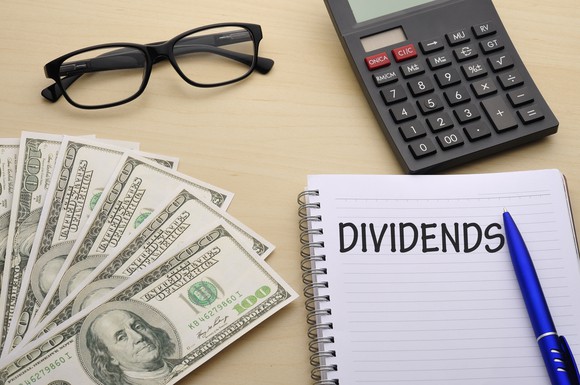
Glasses, calculator, money, and a notebook with word Dividends written in it, all on a tan-colored flat surface.

Image source: Getty Images.

What's a dividend and how does it work?

A dividend is an amount of cash that a company chooses to pay to its shareholders. For each share of stock that you own, the company will pay you a certain amount, and the more stock you own, the greater your total dividend will be. Most companies pay dividends on a regular schedule, with quarterly payments (coming four times a year) being the most common.

The mechanics of how dividends get paid out are a bit tricky to understand. Companies set a date, called the record date, on which they'll look at the current owners of shares and pay dividends to them. A second date, called the ex-dividend date, marks the first day on which purchases and sales of shares will not give the buyer the right to that particular dividend payment. So if the ex-dividend date of a stock is June 30 and I buy the stock on June 25, then I'll get the dividend payment. But if I buy it on July 1, then I won't�receive the dividend payment -- the previous owner will still get the dividend, even if it gets paid out several weeks later.

Many investors look at the dividend yield as an important metric. The dividend yield is equal to the total annual dividend payments divided by the stock price. So if you own a stock priced at $100 per share and it makes quarterly dividend payments of $0.75 per share, then the dividend yield will be 3% -- $0.75 times four quarterly payments in a year equals $3, divided by the $100 per-share price.

Why do investors like monthly dividends?

At first glance, it might seem completely unimportant how often a company pays a dividend. As long as the total amount of the dividend payment is the same over time, whether a company parcels those payments out on an annual, semiannual, quarterly, or monthly basis won't have an impact on how much money goes into your pocket.

From the company's perspective, making dividend payments less often can be a positive. Some companies justify paying dividends less frequently by saying that the expenses of processing each individual dividend can add up, and so making four quarterly payments costs roughly four times as much as making just a single payment annually.

Meanwhile, investors generally fall into two categories with respect to their needs for dividend income. If you don't actually need cash from your portfolio, then you won't value frequent dividend payments as much. That's especially true for those who plan to participate in dividend reinvestment plans, or DRIPs for short. These plans take the dividends that you would have received and, instead, reinvest them into additional shares of the company's stock. This has the benefit of gradually increasing your position in a given stock, but it's not as critical whether those reinvestments happen once, twice, four times, or 12 times a year.

Monthly dividends work best for investors who have regular monthly living expenses and like having income that comes in on a matching schedule. Sure, you can put your quarterly or annual dividend income into a separate bank account and budget it out over three or 12 months. But it's a lot more convenient just to see the money coming in every month and then to arrange to have it put where it can go toward paying your bills in a timely manner without any extra effort.

Why you shouldn't just pick the stocks with the highest yield

If you need portfolio income, the temptation is to go with the investments that will generate as much of it as possible. You can find dividend stocks that have extremely high yields compared to prevailing interest rates.�Yields of 10% or more aren't unheard of, and many more stocks pay dividends in the 5% to 10% range. With most fixed-income investments like bonds and bank CDs paying a whole lot less than that in interest, those high-yielding dividend stocks look awfully tempting.

But there's danger in concentrating entirely on the dividend stocks with the highest yields. In many cases, a yield is high because the company's stock price has fallen dramatically due to troubles with the underlying business. It's possible for companies in those situations to rebound and recover fully without ever having to make any changes to their dividend policies. However, what often happens is that a company has to reduce or even entirely eliminate its dividend in order to preserve capital for its own business needs. When that occurs, it often deals a double blow to income investors: Not only does the shareholder get less income, but the share price typically takes a hit as well.

One way to detect these so-called dividend yield traps is to look at the underlying fundamental business of the company to see whether it has the capacity to support future dividend payments. One simple thing you can do is to compare the total dividends the company pays annually with the company's earnings. If a company earns a lot more than it pays out in dividends, then that puts the company in a better position not only to sustain its past dividend payments but also to boost them in the future. Conversely, if a company pays out more than it earns in dividends, it can be a sign that the size of the current dividend payment is unsustainable, as it suggests that the company might have to borrow money in order to keep paying dividends at their present level. Investors will often refer to the payout ratio, which is the annual dividend rate divided by annual earnings per share, expressed as a percentage. Payout ratios above 100% indicate that a company is paying more in dividends than it's earning, while payout ratios below 100% show a surplus of earnings.

Payout ratios aren't a perfect metric for detecting yield traps, though, because earnings aren't always the best indicator of a company's health. In particular, some of the special types of businesses that are well-known for making monthly dividend payments -- such as real estate investment trusts (REITs), royalty trusts, and business development companies (BDCs) -- have special accounting rules that can distort reported earnings dramatically. For these industries, alternative measures of dividend sustainability can more accurately reflect likely future dividend-related actions. These alternatives include using free cash flow or funds from operations. Free cash flow, which measures the amount of cash a company's operating business generates and then subtracts out money spent on major capital projects, can give a clearer picture of what's happening with the company's actual working cash balance, especially in businesses that have a lot of noncash accounting adjustments that make official earnings misleading. Similarly, funds from operations takes out the adjustments made for depreciation of property and gains and losses on property sales, making it especially useful for real-estate-rich businesses that do many transactions involving property that can distort operating performance.

Also, bear in mind that some companies are required to have certain payout ratios in order to comply with various rules and regulations. For instance, REITs and BDCs get special tax treatment, but in order to get it, they have to pay out 90% of their earnings as dividends. That high of a payout ratio for a regular company might raise doubts about dividend sustainability, as even most mature companies tend to keep payout ratios below the 75% to 80% range in order to give themselves some flexibility for deploying capital back into their businesses. For dividend stocks that have significant growth potential, even lower payout ratios are ideal in order to provide ample capital to take advantage of strategic opportunities as they arise.

Top monthly dividend stocks worth a closer look

With all that as foreground, below are five of the most promising top monthly dividend stocks for investors to consider.

Stock

Current Dividend Yield

Earnings Payout Ratio

AGNC Investment (NASDAQ:AGNC)

11.4%

75%

LTC Properties (NYSE:LTC)

6.5%

104%

Pembina Pipeline (NYSE:PBA)

5.3%

109%

Realty Income (NYSE:O)

5.2%

231%

Shaw Communications (NYSE:SJR)

4.5%

94%

Data source: Yahoo! Finance.

These stocks have different focus areas, but they all offer healthy dividend yields and good track records of making monthly payouts to their shareholders.

AGNC Investment

AGNC Investment is the highest-yielding monthly dividend stock on this list, and that's for a very good reason: It's one of the highest-risk plays as well. AGNC is a real estate investment trust that invests in mortgage-backed securities rather than holding actual real estate, essentially betting that the returns it can earn on its investments will exceed its cost of capital, or how much it has to pay either to banks or other lenders to borrow money or to equity investors for them to be willing to invest in its stock.

The best environment for AGNC is one in which short-term interest rates are low and moving lower. Such an environment allows the mortgage REIT to borrow extensively with short-term financing, using the money it obtains to build up a larger portfolio of longer-maturity mortgage-backed securities. When yields on long-term bonds are substantially greater than the rates on short-term borrowing, AGNC is able to make a substantial profit. Those favorable conditions have prevailed for much of the past decade, and AGNC's total returns -- considering both dividends and share-price movements -- have been good.

The challenge that AGNC now faces is that those conditions appear to be changing. The Federal Reserve has started to boost short-term rates, and the spread between mortgage-backed security yields and financing costs has narrowed significantly. Partially in anticipation of those moves, AGNC has shifted its investing strategy, and that's required the mortgage REIT to reduce its dividend twice since switching to a monthly dividend distribution in 2014. So far, though, AGNC's share price has held up well compared to its peers, and despite the risks, many dividend investors are comfortable with the combination of high yield and long-term growth prospects.

LTC Properties

LTC Properties is also a REIT, but it owns actual properties rather than securities. The initials in the REIT's name provide a hint about its focus area, as it invests in senior housing developments and projects, as well as healthcare-related properties that aim to meet the long-term care demand for the aging U.S. population. LTC's portfolio of more than 200 facilities includes properties that specialize in assisted living, memory care, range-of-care, and post-acute skilled nursing services. The properties that LTC owns and operates through joint ventures, sale-and-leaseback transactions, mortgage financing, preferred equity, and mezzanine lending arrangements span the nation, covering the West Coast, the Southwest, and most of the heartland and the Deep South. Typically, LTC arranges to have partners operate its facilities. The REIT hopes to continue expanding its geographical reach in an effort to take maximum advantage of opportunities in every region of the country.

Unlike AGNC, LTC Properties has a long history of monthly payments that dates back to 2005. Over that span, the REIT has increased its monthly dividend on nine occasions, producing a more than 70% overall increase in what shareholders receive every month over that 13-year time span.

LTC's addressable audience is poised to grow still further. Over the next 45 years or so, the population of senior citizens is expected to double, and number of people over 85 years old will see a threefold increase by 2050. Given that the older segment of retired seniors is the most likely to need the long-term care that LTC's facilities provide, this demographic shift could have dramatic growth implications for the REIT over the long haul -- and for its payout to shareholders.

Pembina Pipeline

Unlike the first two stocks mentioned above, Pembina Pipeline isn't a real estate investment trust. Pembina is a leading pipeline operator and provider of midstream energy infrastructure services, which include things like oil and natural gas pipelines, storage tanks and terminals to facilitate shipment of energy products by land or sea, and wholesale marketing of energy products to downstream businesses like gas stations. It's based in Canada, and the level of activity in the energy industry there has given Pembina plenty of projects to work on in recent years.

Like many midstream energy providers, Pembina hasn't gotten through the past few years of weak oil prices without seeing some pressure on its core business. That showed up not only in its business results but also in its dividend payouts, which fell as crude prices dropped from triple-digit levels to as low as $30 per barrel before rebounding.

The company didn't shy away from investing in opportunities for growth even when markets hadn't yet established themselves on a path back toward sustained price gains, taking on nearly 3 billion Canadian dollars' worth�($2.26 billion) of oil and gas infrastructure projects located mostly in the western Canadian provinces of Alberta and British Columbia. An even bigger strategic move came from Pembina's CA$9.7 billion purchase of midstream peer Veresen announced in May 2017, which combined their portfolios to make the combined company rich in pipeline, terminal, storage, gas processing, and fractionation facility assets.

Now, things are starting to go a lot better for Pembina. The company is working hard to get liquefied natural gas from rich inland gas fields to terminals on the West Coast of the U.S. and Canada, including the Jordan Cove project in Oregon that Pembina is working on. Even as it cuts back slightly on capital spending, Pembina has the potential to reap big rewards from rising energy prices, and that could spur more customers to use its energy infrastructure assets and help support growth for its already solid 5.3% dividend yield.

Realty Income

There's no company that embodies the monthly dividend concept better than Realty Income. The real estate investment trust has even trademarked its claim as The Monthly Dividend Company, and shareholders have reaped the rewards for decades. Realty Income has paid 574 consecutive monthly dividends, and for 82 quarters in a row -- more than 20 years -- the REIT has boosted those monthly payments. With a total return averaging almost 16% annually and dividend growth running at nearly a 5% annual rate, Realty Income is walking the walk when it comes to providing reliable monthly income to its shareholders.

Realty Income comes up with its dividend distributions�by having a highly diversified portfolio of real estate holdings. The REIT has more than 5,300 properties under long-term net lease agreements, which puts the burden on tenants to pay for certain expenses such as property maintenance, insurance coverage, and real estate taxes and therefore leads to a more reliable and predictable stream of net income for Realty Income. Those properties cover all but one state out of the 50. Realty Income has found more than 250 commercial tenants to lease its properties. Although the REIT does have a decidedly retail focus, the company boasts tenants in almost four dozen different industries.

Some investors have worried that Realty Income's retail exposure puts it at risk. With a trend away from mall-based traffic toward e-commerce shopping, the concern is that the tenants that lease space at Realty Income-owned properties will eventually go out of business or move their operations online. Yet Realty Income fights against that risk by concentrating on those portions of the retail industry that are less vulnerable to adverse trends. For instance, many of its tenants are drugstores and other providers of necessary goods and services. Realty Income also counts fitness centers and movie theaters among its key tenants, taking advantage of a shift toward greater provision of services at commercial property locations. Focusing on retailers that offer low prices to their customers also helps to reduce disruptive risks from online competition. With such a long history of success, Realty Income has the experience and know-how to navigate changing trends and find ways to produce the monthly dividend income its shareholders count on.

Shaw Communications

The telecommunications industry has historically been a good one for dividend payers, and Shaw Communications is no exception. As a leading player in the Canadian telecom market, Shaw serves nearly 7 million consumers and enterprise customers with the broadband, voice, and video services that they need. Shaw's monthly dividends work out to a yield of 4.5% currently.

Shaw faces many of the same pressures that its peers in the industry have had to deal with lately. Customers north of the U.S. border are also cutting the cord, and Shaw has seen trends toward falling numbers of subscribers for traditional landline and cable television services. So far, Shaw has done a good job of encouraging customers to boost their broadband service in order to offset the losses on the voice and video side of the business, but some investors still worry about Shaw's future.

Nevertheless, Shaw knows what it needs to do in order to stay ahead of the competition. The telecom giant announced recently that its first 5G technical trials in the Calgary market had gone well, showing that the pace of technological advances is just as important in the Canadian telecom industry as it is for its U.S. counterparts. As with the other Canadian companies on this list, Shaw shareholders who are U.S. residents have to pay attention to the relative values of the Canadian and U.S. dollars in considering what their dividend income will look like. Yet with a long history of solid performance, Shaw has the chops to find new ways to grow in a fast-moving business.

When you think dividends, think monthly

Not all investors need regular income, but if you do, monthly dividend stocks are some of the best investments you can find. By matching up the timing of when you get portfolio income with when you need to spend it on your living expenses, you can be more secure that you'll be able to meet your financial needs from your investments.

Wednesday, June 20, 2018

Wilbur Ross Wins Approval for Short Sale of Kremlin-Linked Firm

LISTEN TO ARTICLE 3:02 SHARE THIS ARTICLE Facebook Twitter LinkedIn Email

Commerce Secretary Wilbur Ross received approval from the top federal ethics agency for short selling the stock of a shipping company linked to close associates of Vladimir Putin.

The review by the Office of Government Ethics was to determine whether the transaction complied with federal ethics laws, including conflict of interest rules. Ross, who wasn’t required to divest his holdings in shipping companies, shorted stock in Navigators Holdings Ltd. on Oct. 31, a day after a reporter from the New York Times contacted Ross seeking comment about his holdings in the company and its dealings with a Russian energy firm.

In his initial financial disclosure form, provided to OGE in January 2017, Ross disclosed that the entities that held his stake in the shipping company, as well as other assets, were valued at $2 million to $10 million. Officials disclose the value of their assets in broad ranges.

“I first sold Navigator stock on May 31, as reported on my public filing,” Ross said in a statement Tuesday. “I later learned in late October that there were more shares belonging to me in an account that the company had opened in electronic form at a firm acting as its agent.”

Ross said he “decided to continue selling those shares, but since I did not have physical possession of them in order to make delivery in the required time period, I technically sold them short and when the shares were delivered by the agent on November 16 I delivered those shares to the broker to close out the transaction. Therefore, it made no economic difference to me whether the shares went up or down between the sale date and the date I delivered them.”

The Commerce Department added in a statement that Ross “continues to follow the guidance” of department ethics officials “to ensure compliance with federal laws and regulations.”

Kremlin Connections

Navigator Holdings’ Kremlin connections came to light in November, when news organizations that are part of the Washington-based International Consortium of Investigative Journalists, whose partners include the New York Times, published reports based on documents leaked from the Bermuda law firm Appleby to the German newspaper Suddeutsche Zeitung that were shared with the consortium.

The documents showed that Navigator Holdings did substantial business with a Russian energy firm called Sibur, whose owners include Russian President Putin’s son-in-law Kirill Shamalov and Gennady Timchenko, a Russian oligarch. Both are subject to American sanctions.

In response to the initial reports in early November, Ross said in a Bloomberg TV interview, “We have no business ties to those Russian individuals who are under sanction.” He added that he had nothing to do with the company’s negotiations with Sibur but that “there’s nothing whatsoever wrong with Navigator having a deal with them.”

Ross held the position until November 16, a second filing with OGE shows. The transaction was valued at $100,000 to $250,000, his federal disclosures show. The OGE issued its approval of the transactions Monday.

OGE also approved a series of transactions made in October in which Ross divested nine W.L. Ross funds worth at least $7.6 million to a trust in which neither he nor his wife has a financial interest. Those transactions were first reported by Forbes magazine.

Tuesday, June 19, 2018

MFA Finl Inc/SH (MFA) Receiving Somewhat Favorable News Coverage, Study Shows

News headlines about MFA Finl Inc/SH (NYSE:MFA) have been trending somewhat positive recently, according to Accern Sentiment. The research firm ranks the sentiment of press coverage by monitoring more than 20 million news and blog sources in real-time. Accern ranks coverage of companies on a scale of negative one to positive one, with scores nearest to one being the most favorable. MFA Finl Inc/SH earned a media sentiment score of 0.18 on Accern’s scale. Accern also gave press coverage about the real estate investment trust an impact score of 46.051519034036 out of 100, indicating that recent press coverage is somewhat unlikely to have an effect on the stock’s share price in the next few days.

NYSE MFA opened at $7.80 on Tuesday. MFA Finl Inc/SH has a fifty-two week low of $6.72 and a fifty-two week high of $8.90. The stock has a market cap of $3.09 billion, a price-to-earnings ratio of 9.87 and a beta of 0.36.

Get MFA Finl Inc/SH alerts:

MFA Finl Inc/SH (NYSE:MFA) last posted its earnings results on Tuesday, May 8th. The real estate investment trust reported $0.20 earnings per share for the quarter, beating the Thomson Reuters’ consensus estimate of $0.18 by $0.02. The company had revenue of $53.20 million for the quarter, compared to analyst estimates of $69.35 million. MFA Finl Inc/SH had a return on equity of 10.06% and a net margin of 78.04%. During the same period last year, the company earned $0.20 earnings per share. equities research analysts anticipate that MFA Finl Inc/SH will post 0.82 EPS for the current year.

The firm also recently declared a quarterly dividend, which will be paid on Tuesday, July 31st. Stockholders of record on Friday, June 29th will be given a $0.20 dividend. This represents a $0.80 annualized dividend and a dividend yield of 10.26%. The ex-dividend date of this dividend is Thursday, June 28th. MFA Finl Inc/SH’s dividend payout ratio is currently 101.27%.

Several equities analysts have weighed in on MFA shares. Zacks Investment Research upgraded MFA Finl Inc/SH from a “sell” rating to a “hold” rating in a report on Thursday, April 19th. ValuEngine lowered MFA Finl Inc/SH from a “buy” rating to a “hold” rating in a report on Wednesday, May 2nd. One research analyst has rated the stock with a sell rating, four have issued a hold rating, one has issued a buy rating and one has given a strong buy rating to the stock. MFA Finl Inc/SH presently has an average rating of “Hold” and a consensus price target of $8.56.

MFA Finl Inc/SH Company Profile

MFA Financial, Inc, through its subsidiaries, operates as a real estate investment trust (REIT) in the United States. The company invests in residential mortgage assets, including non-agency mortgage-backed securities (MBS), agency MBS, residential whole loans, credit risk transfer securities, and mortgage servicing rights related assets.

Insider Buying and Selling by Quarter for MFA Finl Inc/SH (NYSE:MFA)

Monday, May 28, 2018

3 Healthcare Stocks That Are Undeniably Dirt Cheap Right Now

Even in the midst of a market that many view as overpriced, inexpensive stocks can be found. One valuation metric that I like to use to find these potential bargains is the enterprise value-to-EBITDA ratio.

The first component of this metric -- enterprise value (EV) -- is calculated by adding market cap plus debt, minority interest, and preferred shares, then subtracting total cash and cash equivalents. EV represents what it would actually cost to buy a company outright, which makes it more useful than just market cap or stock price.

The second component of the metric is EBITDA -- earnings before interest, taxes, depreciation, and amortization. One advantage to using EBITDA instead of net income is that it isn't affected by how a company finances its balance sheet (for example, through debt, issuing equity, or both).

A low EV-to-EBITDA measurement is a pretty good indicator that a stock is relatively cheap. And there are three healthcare stocks that are undeniably dirt cheap right now based on the metric: United Therapeutics (NASDAQ:UTHR), Gilead Sciences (NASDAQ:GILD), and Humana (NYSE:HUM). But are these cheap stocks smart picks to buy?

Businessman touching screen displaying heartbeat line and dollar symbol

Image source: Getty Images.

1. United Therapeutics

United Therapeutics claims a super-low EV-to-EBITDA ratio of 3.98. You won't find many stocks that are less expensive using the metric. But why is the biotech so cheaply priced?

A lot of United Therapeutics' low valuation stems from the threats the company faces from generic competition. Pulmonary arterial hypertension (PAH) drugs Remodulin and Adcirca generated $671 million and $420 million in sales, respectively, in 2017. Revenue from these drugs will probably fall with generic versions�likely to reach the market this summer.�

The biotech does have three other approved drugs -- Tyvaso, Orenitram, and Unituxin. However, these drugs combined contributed less than 37% of United Therapeutics' total revenue last year. Also, the patents for Tyvaso are being challenged by a leading generic-drug maker.�

United Therapeutics' pipeline includes seven candidates that could win approval over the next three years. Five of these candidates are new formulations or combinations of the company's existing drugs. It remains to be seen if these drugs can turn things around for United Therapeutics.��

2. Gilead Sciences

Gilead Sciences' EV-to-EBITDA ratio currently stands at 6.39. This value is well below that of other big biotechs in Gilead's peer group. As is the case with United Therapeutics, though, there's an easily identifiable reason behind Gilead's low valuation.

For Gilead, that reason is sinking hepatitis C virus (HCV) product sales. The biotech once enjoyed staggering growth, thanks to its HCV franchise. Gilead is largely a victim of its own success, though. So many patients were cured that there are fewer patients remaining who need treatment. In addition, Gilead now has a formidable rival in the HCV market with AbbVie.

Despite these HCV woes, however, there are several reasons to think that the future could be brighter for Gilead. The biotech's management team thinks that HCV sales will stabilize. Gilead recently launched new HIV drug Biktarvy, which is practically a sure bet for becoming a megablockbuster success.�

The company's pipeline could also help Gilead's fortunes improve in the not-too-distant future. Two candidates that especially stand out are selonsertib, which targets treatment of non-alcoholic steatohepatitis (NASH), and autoimmune disease drug filgotinib.�

3. Humana

Humana claims an EV-to-EBITDA ratio of 6.97. The big health insurer's main rivals are much more expensive. The primary reason behind Humana's relatively low valuation can be found on its balance sheet.

While Humana's market cap is around $40 billion, the company's enterprise value is less than $26 billion. Why this big gap? Humana's cash stockpile, including cash, cash equivalents, and marketable securities, totaled $18.6 billion at the end of the first quarter. The company's total debt was only $5.3 billion.

At least one deep-pocketed investor seems to find Humana's valuation attractive. The Wall Street Journal reported last month that Walmart�was in early talks about acquiring Humana. There are several reasons the huge retail company could be interested in moving into health insurance. So far, though, no final deal has been announced.

Even if Walmart doesn't buy Humana, the health insurer appears to be in solid shape. Humana's Medicare Advantage business is booming. After posting great Q1 results earlier this month, the company upped its full-year 2018 earnings guidance.��

But are they buys?

Just because something is cheap doesn't mean you should buy it. Sometimes, the low valuation should instead be a warning sign to stay away.

I think that's the case with one of these stocks. United Therapeutics faces huge challenges that I suspect will cause its stock to drop even more.�However, my view is that it's a different story for Gilead Sciences and Humana.

The ingredients are there for Gilead to make a comeback. I think that stabilization in the company's HCV sales is a matter of when -- rather than if. I like the prospects for Biktarvy and for Gilead's pipeline.�I also like Humana's position in the marketplace. An acquisition by Walmart seems like a smart move in my opinion.�

All three of these healthcare stocks are cheap for a reason. But I predict that Gilead and Humana will only be cheap for a season.

Sunday, May 27, 2018

Hot Dividend Stocks To Invest In 2018

tags:GPC,UNH,BOOM,

As we close out 2017, it’s good to remind ourselves of what worked, and what didn’t. This past year, though, makes this introspective exercise rather tricky. Although Wall Street early on forecasted a rough 2017, the end result was quite the opposite. Benchmark indices hit all-time records, while most sectors witnessed tremendous optimism. Who needs dividend stocks at a time like this?

This also means that inferior investment strategies were masked by secular bullishness. The new year may not be as forgiving, which is why I’m recommending investors to get selective. Fortunately, with dividend stocks, you don’t have to feel pressured into always picking winners.

At its core, choosing the right dividend stocks to buy is about options. Although picking high-flying growth companies is the sexiest endeavor, it isn’t always the smartest. With passive-income yielding firms, you get the potential for making capital gains, and also residual payouts to bolster your position. During a down period, dividends can also help you ride out the storm.

Hot Dividend Stocks To Invest In 2018: Genuine Parts Company(GPC)

Advisors' Opinion:
  • [By ]

    Genuine Parts Co. (NYSE: GPC)
    Ok, now I know I've definitely locked in the broken record award. GPC is better known to consumers as NAPA auto parts. And aftermarket auto parts is probably one of the most lucrative businesses in the United States for too many reasons to cover now.

  • [By Shane Hupp]

    Bruderman Asset Management LLC lessened its stake in shares of Genuine Parts (NYSE:GPC) by 37.9% in the 1st quarter, Holdings Channel reports. The firm owned 4,091 shares of the specialty retailer’s stock after selling 2,495 shares during the quarter. Bruderman Asset Management LLC’s holdings in Genuine Parts were worth $368,000 as of its most recent filing with the Securities and Exchange Commission (SEC).

  • [By Joseph Griffin]

    Get a free copy of the Zacks research report on Genuine Parts (GPC)

    For more information about research offerings from Zacks Investment Research, visit Zacks.com

  • [By ]

    2. Price To Sales�
    Another useful metric is the price-to-sales ratio (P/S). P/S measures a company's market cap versus its annual revenue number. The idea is that the lower the number, the greater the implied value. For example, Snap, Inc. (Nasdaq: SNAP) trades at 26.9 times sales, an incredibly expensive number. However, aftermarket auto parts giant Genuine Parts (NYSE: GPC) trades at just 0.88 times sales -- 88 cents to every dollar of sales the company brings in. Often, the lower the number, the more inefficiently the market has mispriced the stock.

  • [By Ethan Ryder]

    DekaBank Deutsche Girozentrale lessened its position in shares of Genuine Parts (NYSE:GPC) by 64.0% during the 1st quarter, according to the company in its most recent 13F filing with the SEC. The firm owned 11,092 shares of the specialty retailer’s stock after selling 19,733 shares during the quarter. DekaBank Deutsche Girozentrale’s holdings in Genuine Parts were worth $1,065,000 at the end of the most recent reporting period.

Hot Dividend Stocks To Invest In 2018: UnitedHealth Group Incorporated(UNH)

Advisors' Opinion:
  • [By Paul Ausick]

    UnitedHealth Group Inc. (NYSE: UNH) traded down 0.80% at $224.07. The stock’s 52-week range is $156.09 to $231.77. Volume was about 40% below the daily average of around 3 million shares. The company had no specific news Wednesday

  • [By Dan Caplinger]

    Health insurance giant UnitedHealth Group (NYSE:UNH) has done an admirable job of navigating the ever-changing landscape of healthcare reform over the past several years. The company was slow to embrace the health insurance exchanges set out in the Affordable Care Act, and that helped leave UnitedHealth less vulnerable when the Trump administration sought to repeal and replace Obamacare. Even as many focused on the positives of tax reform, UnitedHealth had to find ways to navigate the return of the excise tax on health insurance premiums in 2018 without seeing a material negative impact to its bottom line.

  • [By Chris Lange]

    UnitedHealth Group Inc. (NYSE: UNH) is scheduled to share its quarterly report on Tuesday as well. The consensus estimates are $2.91 in EPS on $54.8 billion in revenue. Shares were last seen at $224.28. The stock has a 52-week range of $164.96 to $250.79, and the consensus price target is $271.67.

  • [By Paul Ausick]

    UnitedHealth Group Inc. (NYSE: UNH) traded up 1.73% at $233.18. The stock’s 52-week range is $166.65 to $250.79. Volume was about 60% below the daily average of around 3.5 million shares. The company had no specific news.

Hot Dividend Stocks To Invest In 2018: Dynamic Materials Corporation(BOOM)

Advisors' Opinion:
  • [By Lisa Levin]

    DMC Global Inc. (NASDAQ: BOOM) shares shot up 23 percent to $39.00 after the company reported upbeat Q1 results and issued upbeat Q2 guidance.

    Shares of eHealth, Inc. (NASDAQ: EHTH) got a boost, shooting up 16 percent to $18.64 as the company posted upbeat Q1 results.

  • [By Lisa Levin]

    DMC Global Inc. (NASDAQ: BOOM) shares shot up 25 percent to $39.55 after the company reported upbeat Q1 results and issued upbeat Q2 guidance.

    Shares of Knowles Corporation (NYSE: KN) got a boost, shooting up 15 percent to $12.83 as the company reported Q1 results.

  • [By Lisa Levin]

    DMC Global Inc. (NASDAQ: BOOM) shares shot up 26 percent to $39.85 after the company reported upbeat Q1 results and issued upbeat Q2 guidance.

    Shares of eHealth, Inc. (NASDAQ: EHTH) got a boost, shooting up 19 percent to $19.04 as the company posted upbeat Q1 results.

  • [By Lisa Levin] Gainers Genprex, Inc. (NASDAQ: GNPX) jumped 46.7 percent to $16.1331. The low-float small-cap clinical stage gene therapy company saw its stock rally nearly 150 percent from Monday through Thursday. Formal news hasn't been announced this week that would support a triple-digit percentage rally (including more than 200 percent at one point on Thursday) but the quiet period following its initial public offering will expire on May 8. Celyad SA (NASDAQ: CYAD) shares gained 24.7 percent to $36.17. Celyad reported the publication of THINK study case report of CYAD-01 Induced Complete Remission in relapsed/refractory AML patient in haematologica. DMC Global Inc. (NASDAQ: BOOM) shares jumped 23.2 percent to $39.00 after the company reported upbeat Q1 results and issued upbeat Q2 guidance. eHealth, Inc. (NASDAQ: EHTH) gained 21.8 percent to $19.58 as the company posted upbeat Q1 results. Enova International, Inc. (NYSE: ENVA) climbed 20.4 percent to $27.20 following Q1 results. SVB Financial Group (NASDAQ: SIVB) shares jumped 18.2 percent to $304.135 following strong quarterly results. Knowles Corporation (NYSE: KN) gained 13.9 percent to $12.70 as the company reported Q1 results. Zymeworks Inc. (NYSE: ZYME) gained 13.8 percent to $17.36. Cocrystal Pharma, Inc. (NASDAQ: COCP) rose 11.8 percent to $2.336 after declining 25.09 percent on Thursday. ImmunoGen, Inc. (NASDAQ: IMGN) shares surged 11.7 percent to $11.75 after the company announced 'successful completion of interim analysis' for FORWARD I Phase 3 mirvetuximab soravtansine trial. Eloxx Pharmaceuticals, Inc. (NASDAQ: ELOX) gained 9.5 percent to $12.70. Expedia Group, Inc. (NASDAQ: EXPE) shares rose 8.5 percent to $115.3801 after the company reported stronger-than-expected earnings for its first quarter on Thursday. Sprint Corporation (NYSE: S) shares rose 8.3 percent to $6.50. The stock moved higher after a Reuters report suggested ongoing merger talks with T-M
  • [By Lisa Levin] Gainers Cocrystal Pharma, Inc. (NASDAQ: COCP) rose 15.3 percent to $2.41 in pre-market trading after declining 25.09 percent on Thursday. Expedia Group, Inc. (NASDAQ: EXPE) shares rose 10.7 percent to $117.75 in pre-market trading after the company reported stronger-than-expected earnings for its first quarter on Thursday. DMC Global Inc. (NASDAQ: BOOM) rose 10.6 percent to $35.00 in pre-market trading after reporting Q1 results. Genprex, Inc. (NASDAQ: GNPX) rose 10.2 percent to $12.12 in pre-market trading after climbing 86.76 percent on Thursday. Sprint Corporation (NYSE: S) shares rose 7 percent to $6.42 in pre-market trading on reports that the company has made progress on merger talks with T-Mobile. Amazon.com, Inc. (NASDAQ: AMZN) rose 6.9 percent to $1,621.95 in pre-market trading after the company posted upbeat results for its first quarter. The company sees second quarter operating income of $1.1 billion - $1.9 billion and sales of $51 billion - $54 billion. Riot Blockchain, Inc. (NASDAQ: RIOT) shares rose 5.5 percent to $7.88 in pre-market trading after gaining 1.49 percent on Thursday. Intel Corporation (NASDAQ: INTC) rose 5.3 percent to $55.86 in pre-market trading as the company reported better-than-expected results for its first quarter and also raised its FY18 sales outlook. 8x8, Inc. (NASDAQ: EGHT) rose 5.3 percent to $21.00 in pre-market trading. Southwestern Energy Company (NYSE: SWN) shares rose 5.1 percent to $4.75 in pre-market trading as the company reported better-than-expected earnings for its first quarter. Diamond Offshore Drilling, Inc. (NYSE: DO) rose 5 percent to $20.24 in pre-market trading. Baidu, Inc. (NASDAQ: BIDU) rose 4.5 percent to $249.50 in pre-market trading following upbeat Q1 profit. Charter Communications, Inc. (NASDAQ: CHTR) rose 4.3 percent to $311 in pre-market trading. Charter is expected to release quarterly earnings today. SINA Corporation (NASDAQ: SINA) shares rose 3.9 pe

Friday, May 25, 2018

General Mills' 30% Upside Looks Appetizing

Top brands that command premium pricing and customer loyalty can create significant competitive advantages over peers. General Mills, Inc (NYSE: GIS) offers a portfolio of leading brands and recently acquired high-growth pet food leader Blue Buffalo. Center-store weakness persists, but trading at 5-year lows and showing nearly 30 percent upside General Mills looks attractive for value investors. The Power of a Brand

When Warren Buffett began practicing Benjamin Graham's style of value investing, he didn't give much thought to brands or business quality. Graham's net-net strategy (stocks selling for less than net current assets) inherently provided the margin of safety that value investors require.

It was only when Charlie Munger introduced Buffett to the idea of the power of brands that Buffett tweaked his style. One of Buffett's well-known successes with the investment shift was See's Candies. To understand the power of See's brand, Buffett once explained:

"If you give your girlfriend See's Candy and she kisses you, we've got you for life."

Later, Buffett recognized a similar brand loyalty from The Coca-Cola Co (NYSE: KO) customer:

"If you gave me $100 billion and said take away the soft drink leadership of Coca-Cola in the world, I'd give it back to you and say it can't be done."

That degree of brand power is rare, of course. Still, searching for solid brands at an attractive stock price was how Buffett evolved as a value investor.

Today's value investors might consider consumer packaged foods leader General Mills, Inc. (NYSE: GIS). General Mills offers a portfolio of well-known brands and finbox.io valuation models show nearly 30 percent upside.

The General Mills Business Model

General Mills' generated $15.6 billion in consolidated net sales with an additional $1.0 billion from its proportionate share of joint venture net sales ($0.8 billion from Cereal Partners Worldwide and $0.2 billion from Häagen-Dazs Japan). The company is managed under four operating segments: North America Retail (65 percent fiscal 2017 net sales), Convenience Stores & Foodservice (12 percent), Europe & Australia (12 percent) and Asia & Latin America (11 percent). Products are split among five global categories including snacks, ready-to-eat cereal, convenient meals, yogurt, and super-premium ice cream:

General Mills' 30% Upside Looks Appetizing

Source: General Mills 2017 Annual Report

General Mills sells its products through retail stores and supplies products to the North American foodservice and commercial baking industries. Popular brands include Cheerios, Wheaties, Betty Crocker, Green Giant, Pillsbury, Haagen-Dazs, and Yoplait. Walmart Inc. (NYSE: WMT) represented 20 percent of the company's 2017 consolidated net sales and 29 percent of its North America Retail segment.

Latest Quarterly Results, "Moat" Analysis, and Growth Outlook

Third-Quarter Results

In its third quarter, General Mills posted a 1 percent increase in organic net sales and net sales increased 2 percent to $3.9 billion. The North America Retail unit sales were up 1 percent compared to the previous year. Results were helped by the Canada operating unit (6 percent increase), U.S. snacks (3 percent), and U.S. Meals & Baking (2 percent), but were pressured by U.S. Yogurt (-8 percent) and cereal (-1 percent).

Management cited increases in freight and commodity costs as weighing on its adjusted diluted EPS of $0.79 (an 8 percent increase in constant currency). To help offset these costs, strategic initiatives include increasing freight carriers and alternative transportation as well as optimizing the distribution network and its administrative structure.

The General Mills "Moat"

As management works to trim costs, General Mills' strong lineup of brands and wide scale look to continue to give it a competitive advantage over peers. Cheerios, Honey Nut Cheerios, and Cinnamon Toast Crunch are all top-5 leading brands in ready-to-eat cereal. Leading brands including Old El Paso, Haagen-Dazs, Yoplait, and Pillsbury round out the rest of General Mills' categories. The quality of these brands can command pricing power and superior shelf space over peers. General Mills' wide distribution lowers unit costs versus smaller peers and its larger scale helps to maximize advertising's impact. In all, it seems General Mills has built a significant competitive advantage versus its peers.

Sources of Growth

This isn't to say that General Mills and other packaged food companies aren't facing challenges. Center-store weakness (as customers move to fresher foods on the perimeter) has taken its toll. To compensate, management plans to reinvest in its brands and new products. Its acquisition of Blue Buffalo, while at a premium price, should also provide some support to top-line growth while supporting General Mills' overall moat. Blue Buffalo is the leader (30 percent+ market share) in the U.S. pet food's wholesome natural segment with 12 percent sales growth and a 25 percent EBITDA margin. Also helping margins is management's targeting of $750 million in annual savings (including $50 million Blue Buffalo synergies).

Estimating Generals Mills' Intrinsic Value

While Buffett moved on from Graham's net-net strategy to buying quality brands, he still required his investments to trade at a reasonable discount, or margin of safety. Buffett held over this principle to provide protection against unfavorable business developments.

So does General Mills offer much in the way of a margin of safety? It sure looks like it. Wall Street analysts expect low single-digit revenue growth to ramp up into the high-single digits with steady EBITDA margin expansion:

General Mills' 30% Upside Looks Appetizing

Source: General Mills 5-Year DCF Model, finbox.io

Incorporating these projections across nine finbox.io valuation models generates an average fair value of $53.53 per share. That estimate implies nearly 30 percent upside to current trading levels:

General Mills' 30% Upside Looks Appetizing

Source: finbox.io

That's more upside compared to General Mills' direct peers and its dividend yield also compares favorably:

General Mills' 30% Upside Looks Appetizing

Risks:

Greater-than-expected weakness in the center store could weigh on General Mills' top line. Volatile commodity costs and increased competition from incumbents and smaller players also pose risks. The Blue Buffalo integration and capturing the targeted $50M in synergies could also prove challenging.

General Mills Conclusion:

With a portfolio of leading brands and a recent acquisition of another, General Mills offers the high-quality brands that value investors seek out. Though customers have prioritized perimeter store offerings of late, brand reinvestment and new product development look to support the top line. With a 4.7 percent dividend yield and 30 percent upside, it's time value investors give General Mills another look.

Photo Credit: General Mills 2017 Annual Report

Author: Andy Pai

Expertise: financial modeling, mergers & acquisitions

Andy is also a founder at finbox.io, where he's focused on building tools that make it faster and easier for investors to do investment research. Andy's background is in investment banking where he led the analysis on over 50 board advisory engagements involving mergers and acquisitions, fairness opinions and solvency opinions. Some of his board advisory highlights:

Sears Holdings Corp.'s $620 mm spin-off via rights offering of Sears Outlet, Hometown Stores and Sears Hardware Stores. Cerberus Capital Management's $3.3 bn acquisition of SUPERVALU Inc.'s New Albertsons, Inc. assets.

Andy can be reached at andy@finbox.io.

As of this writing, I did not hold a position in any of the aforementioned securities and this is not a buy or sell recommendation on any security mentioned.

General Mills' 30% Upside Looks Appetizing

Thursday, May 24, 2018

day trading futures

tags:GLMD,CHK,QNST,PF,

Samsung�(NASDAQOTH:SSNLF) Electronics recently reported its financial results for the first quarter of 2018. Samsung Electronics is a large conglomerate that consists of many different businesses, but the one that many consumers, and even investors, focus on is its mobile device business, which is the largest smartphone maker in the world by unit shipment volumes.

Last quarter, Samsung's mobile business performed quite well, with revenue up 23% year over year and operating profit up 82%. The company attributes this strong performance to the early launch of its flagship smartphones, the Galaxy S9 and Galaxy S9 Plus, as well as continued sales of its prior-generation Galaxy S8 series devices.

Image source: Samsung.

However, in the coming quarter, Samsung says that it expects a decline in the profitability of its mobile business caused by "stagnant sales of flagship models amid weak demand and an increase in marketing expenses to address the situation."�

day trading futures: Galmed Pharmaceuticals Ltd.(GLMD)

Advisors' Opinion:
  • [By Shane Hupp]

    Here are some of the media stories that may have effected Accern’s rankings:

    Get Galmed Pharmaceuticals alerts: Galmed Pharmaceuticals’ (GLMD) CEO Allen Baharaff on Q1 2018 Results – Earnings Call Transcript (seekingalpha.com) What You Must Know About Galmed Pharmaceuticals Ltd��s (NASDAQ:GLMD) Market Risks (finance.yahoo.com) Obeticholic Acid Market Analysis, Recent Trends and Regional Growth Forecast by Types, Applications and Economic … (theexpertconsulting.com) oholic Steatohepatitis (NASH) Market 2023: Know Marketing Channel Future Trend, Growth and Price with Future … (theexpertconsulting.com) Umbilical Cord Blood May Offer Early FH Diagnosis (medscape.com)

    A number of equities analysts have recently commented on GLMD shares. ValuEngine lowered shares of Galmed Pharmaceuticals from a “hold” rating to a “sell” rating in a report on Wednesday, February 14th. Maxim Group set a $14.00 price target on shares of Galmed Pharmaceuticals and gave the stock a “buy” rating in a report on Wednesday, May 9th. Finally, HC Wainwright lifted their price target on shares of Galmed Pharmaceuticals from $18.00 to $24.00 and gave the stock a “buy” rating in a report on Monday, February 12th. Two research analysts have rated the stock with a hold rating and four have assigned a buy rating to the company. The company currently has an average rating of “Buy” and an average price target of $20.40.

day trading futures: Chesapeake Energy Corporation(CHK)

Advisors' Opinion:
  • [By Paul Ausick]

    Chesapeake Energy Corp. (NYSE: CHK) dropped more than 10% Friday to post a new 52-week low of $2.53 after closing at $2.82 on Thursday. The stock’s 52-week high is $6.59. Volume was around 55 million, almost double the daily average of about 30 million. The company had no specific news, but tumbling oil & natural gas prices simply punish this stock.

  • [By Paul Ausick]

    Here’s how share prices of the largest U.S. natural gas producers reacted to today’s report:

    Exxon Mobil Corp. (NYSE: XOM), the country’s largest producer of natural gas, traded down about 2.4%, at $80.21 in a 52-week range of $72.16 to $89.30. Chesapeake Energy Corp. (NYSE: CHK) traded down about 1.8%, at $4.55 in a 52-week range of $2.53 to $5.68. EOG Resources Inc. (NYSE: EOG) traded down about 2.1% to $120.38. The 52-week range is $81.99 to $128.03.

    Also, the United States Natural Gas ETF (NYSEARCA: UNG) traded up about 0.3%, at $23.99 in a 52-week range of $20.40 to $29.96.

  • [By Paul Ausick]

    Chesapeake Energy Corp. (NYSE: CHK) dropped about 4.6% Friday to match a 52-week low of $3.30 after closing at $3.46 on Thursday. The stock’s 52-week high is $6.65. Volume was around 35 million, about 25% above the daily average of around 28.8 million. The company had no specific news.

  • [By Logan Wallace]

    Chesapeake Energy (NYSE:CHK) – Analysts at Jefferies Group boosted their Q2 2019 earnings per share estimates for shares of Chesapeake Energy in a research note issued to investors on Tuesday, May 15th. Jefferies Group analyst M. Lear now forecasts that the oil and gas exploration company will post earnings per share of $0.10 for the quarter, up from their prior estimate of $0.09. Jefferies Group also issued estimates for Chesapeake Energy’s Q1 2020 earnings at $0.22 EPS and FY2020 earnings at $0.86 EPS.

  • [By Lisa Levin] Gainers SenesTech, Inc. (NASDAQ: SNES) shares surged 296.07 percent to close at $1.25 on Monday after the California Department of Pesticide Regulation proposed to register the company's ContraPest for sale and use in California. AgEagle Aerial Systems, Inc. (NASDAQ: UAVS) shares gained 19.59 percent to close at $2.93. TransGlobe Energy Corporation (NASDAQ: TGA) rose 18.39 percent to close at $2.64 on Monday. Sears Hometown and Outlet Stores, Inc. (NASDAQ: SHOS) shares gained 15.91 percent to close at $2.55. VAALCO Energy, Inc. (NYSE: EGY) shares jumped 14.9 percent to close at $2.39. Resonant Inc. (NASDAQ: RESN) climbed 13.96 percent to close at $4.49. Chesapeake Energy Corporation (NYSE: CHK) shares rose 13.55 percent to close at $4.61 on Monday. Lilis Energy, Inc. (NYSE: LLEX) surged 13.09 percent to close at $5.01. MB Financial, Inc. (NASDAQ: MBFI) gained 12.9 percent to close at $49.28. Fifth Third Bancorp (NASDAQ: FITB) agreed to acquire MB Financial for $54.70 per share in cash and stock. TransEnterix, Inc. (NYSE: TRXC) shares rose 12.83 percent to close at $3.43. World Wrestling Entertainment, Inc. (NYSE: WWE) jumped 12.52 percent to close at $57.86 on Reports that it has reached a deal with Fox for Its 'Smackdown Live' program. Eastman Kodak Company (NASDAQ: KODK) rose 12.38 percent to close at $5.90. NuCana plc (NASDAQ: NCNA) climbed 11.94 percent to close at $26.44. NuCana appointed Dr. Cyrille Leperlier to its Board as an independent non-executive Director. Aqua Metals, Inc. (NASDAQ: AQMS) rose 11.83 percent to close at $3.97 on Monday. Huami Corporation (NYSE: HMI) shares jumped 11.27 percent to close at $10.17 following Q1 results. 21Vianet Group, Inc. (NASDAQ: VNET) gained 9.55 percent to close at $7.34. Boxlight Corporation (NASDAQ: BOXL) rose 8.56 percent to close at $7.86 after the company announced an exclusive partnership with Multi Touch Interactives to strengthen the de

day trading futures: QuinStreet, Inc.(QNST)

Advisors' Opinion:
  • [By Joseph Griffin]

    QuinStreet (NASDAQ:QNST) Director James R. Simons sold 229,718 shares of the company’s stock in a transaction on Thursday, May 17th. The stock was sold at an average price of $12.39, for a total transaction of $2,846,206.02. The sale was disclosed in a legal filing with the SEC, which can be accessed through the SEC website.

  • [By Dan Caplinger]

    The mood was negative on Wall Street on Wednesday, and most major benchmarks finished in the red. Strength in the technology sector wasn't enough to lift more cyclically focused benchmarks like the Dow Jones Industrial Average, and the combination of an attack on Saudi Arabia that sent oil prices higher and some disquieting readings on the inflation front kept investors from feeling more confident about stocks going into earnings season. In addition, some individual companies had bad news that sent their shares lower. Analogic (NASDAQ:ALOG), QuinStreet (NASDAQ:QNST), and MSC Industrial Direct (NYSE:MSM) were among the worst performers on the day. Here's why they did so poorly.

day trading futures: Pinnacle Foods, Inc.(PF)

Advisors' Opinion:
  • [By Ethan Ryder]

    Synovus Financial Corp acquired a new stake in shares of Pinnacle Foods (NYSE:PF) in the first quarter, HoldingsChannel reports. The fund acquired 2,094 shares of the company’s stock, valued at approximately $113,000.

  • [By Ethan Ryder]

    Pinnacle Foods (NYSE:PF) had its target price increased by Deutsche Bank from $61.00 to $66.00 in a report issued on Friday. Deutsche Bank currently has a buy rating on the stock.

  • [By Logan Wallace]

    Pinnacle Foods (NYSE:PF) – Research analysts at Jefferies Group dropped their Q2 2018 EPS estimates for Pinnacle Foods in a research report issued on Tuesday, May 8th. Jefferies Group analyst A. Jagdale now forecasts that the company will post earnings per share of $0.56 for the quarter, down from their prior forecast of $0.58. Jefferies Group currently has a “Buy” rating and a $72.00 target price on the stock. Jefferies Group also issued estimates for Pinnacle Foods’ Q1 2019 earnings at $0.62 EPS, Q2 2019 earnings at $0.62 EPS, Q3 2019 earnings at $0.76 EPS, Q4 2019 earnings at $1.15 EPS, FY2019 earnings at $3.16 EPS and FY2020 earnings at $3.44 EPS.

  • [By Shane Hupp]

    Pinnacle Foods (NYSE:PF) last posted its earnings results on Thursday, May 3rd. The company reported $0.57 earnings per share for the quarter, topping the Zacks’ consensus estimate of $0.56 by $0.01. Pinnacle Foods had a net margin of 17.93% and a return on equity of 14.39%. The firm had revenue of $778.83 million for the quarter, compared to analyst estimates of $767.94 million. During the same period in the previous year, the firm posted $0.50 EPS. The company’s revenue for the quarter was up 1.7% compared to the same quarter last year. equities research analysts predict that Pinnacle Foods will post 2.89 EPS for the current year.

  • [By Jeremy Bowman]

    Shares of�Pinnacle Foods Inc.�(NYSE:PF) were moving higher in April after the packaged-foods company became a target of activist investor Jana Partners. As a result the stock finished the month up 12%, according to data from S&P Global Market Intelligence.�