Sunday, July 22, 2018

Merck pledges to cut prices for seven drugs

Merck joined fellow pharmaceutical giants Novartis and Pfizer on Thursday in pledging to limit drug price increases in the United States.

Merck said it's cutting the price of Zepatier, a drug that treats hepatits C, by 60% and reducing the price of six other medications by 10% each.

The company also said it will not raise the average price of the drugs it sells beyond the annual rate of inflation in the United States and will continue to "evaluate our portfolio to look for opportunities to further reduce costs."

The six medications targeted for 10% price cuts are:

�� Prinivil, treats high blood pressure and heart conditions

�� Proscar, treats enlarged prostate

�� Remeron, antidepressant

�� Sinemet, treats symptoms of Parkinson's disease

�� Sinemet (sustained-release)

�� Trusopt, treats symptoms of glaucoma and other eye diseases

The move by Merck (MRK) comes after Pfizer (PFE) announced price hikes for nearly three dozen drugs only to reverse course amid public pressure from President Donald Trump.

Trump in a tweet earlier this month lambasted what he called Pfizer's plans to raise prices "for no reason."

The company announced last week it would halt raising prices on multiple drugs. The company did not, however, roll back price hikes already implemented this year, including on popular medications like Xanax, Lipitor and Chantix.

Swiss firm Novartis followed, pledging not to raise drug prices in the United States this year. The company plans to "evaluate as the environment evolves," Novartis CEO Vas Narasimhan told Bloomberg this week.

The pharmaceutical industry has been the subject of criticism because of climbing drug prices. Trump has promised to pressure the industry to lower drug prices.

However, his administration did little until May, when it rolled out its 44-page "blueprint" for increasing competition, reducing regulations and changing the incentives for all players in the drug industry.

Merck said in a press release Thursday that it has "a long history of responsible drug pricing." Last year, the average net price of all the medications it sells in the United States declined by 1.9%.

�� Charles Riley, Danielle Wiener-Bronner and Tami Luhby contributed to this report.

Thursday, July 19, 2018

Expanded Stock Buyback Parameters for Warren Buffett Could Bring Conflict

Berkshire Hathaway Inc. (NYSE: BRK-A) (NYSE: BRK-B) is not your traditional company. Not by a long shot. The conglomerate run by Warren Buffett and team has two classes of stock and many investors consider it as so diversified that its returns should now simply mirror the stock market or other simple index-performance metrics. That said, this is Buffett’s company and he wants to grow the book value per share for shareholders faster than the overall market.

One issue that can influence any per share calculations (book value, earnings, and so on) is stock buybacks. It turns out that Berkshire Hathaway does have an allowance and formula for repurchasing shares of its own common stock. Up until now, Buffett and his team could repurchase Berkshire Hathaway shares at a price that would not exceed a 20% premium over the current book value of those shares at the time the buybacks occur.

That was then. Now Berkshire Hathaway is creating a new rule for when Warren Buffett and other members inside of the company can repurchase shares of their common stock. Buffett and Charlie Munger have just handed themselves an open checkbook that can be used for buying back stock any time and arguably for any price or reason. A press release on Tuesday evening said:

The Board of Directors of Berkshire Hathaway Inc. has today authorized an amendment to Berkshire��s share repurchase program.� The earlier share repurchase program provided that the price paid for repurchases would not exceed a 20% premium over the then-current book value of such shares.� Under the amendment adopted by the Board of Directors, share repurchases can be made at any time that both Warren Buffett, Berkshire��s Chairman and CEO, and Charlie Munger, a Berkshire Vice Chairman, believe that the repurchase price is below Berkshire��s intrinsic value, conservatively determined.

Let’s think about what this might mean when you break it down. The amendment includes “at any time” and “believe the repurchase price is below Berkshire’s intrinsic value” and “conservatively determined.” The long and short of the matter is that Buffett and Munger only have to publicly say they thought their stock was cheap at any given time.

The good news here for Berkshire Hathaway shareholders is that there are still at least some restrictions placed upon the company that would keep the Buffett-Munger team from going overboard on share repurchases. The company cannot drop under that $20 billion in perceived liquidity by buying back too much stock. The release said:

The current policy whereby share repurchases will not be made if they would reduce the value of Berkshire��s consolidated cash, cash equivalents and U.S. Treasury Bills holdings below $20 billion will continue.� Berkshire will not initiate any share repurchases under the amended program until it publicly releases its second quarter earnings, currently scheduled after the close of the markets on�Friday, August 3, 2018.

Berkshire Hathaway ended 2017 with more than $100 billion between its cash and short-term investments, and it had over $200 billion in long-term investments. Its total assets at year-end tallied up to $702 billion, just over twice as much as its $350 billion in total liabilities. Berkshire Hathaway’s last seen market capitalization, the value at which the equity markets value the company on any given day, was last seen at $472 billion.

Some investors will cheer this news because it will simplify the repurchase criteria to “any day the stock can be justified as cheap, as long as there is $20 billion in the bank.” Other investors will argue that this opens up the company to corporate governance issues wherein management (remember, neither Buffett nor Munger are likely to live forever) has too little control over when it should be buying back stock versus making acquisitions that can grow the company as a whole over time.

ALSO READ: Gold and Precious Metals Moving Toward Lows of the Year

It might be easy to see at least some of the obvious potential conflicts that could arise from this corporate governance change. When you throw in Buffett, it’s easy to assume he would win any argument over what “cheap or value” is on any given day. Then again, Buffett has admitted many times he is not immune from making mistakes.

Berkshire Hathaway’s A-shares closed down $500.00 at $288,500.00 and the B-shares closed down $1.59 at $190.41 on Tuesday. As of Tuesday’s closing bell, the shares were down roughly 4% so far in 2018.

Friday, July 13, 2018

Cramer: Pizza execs say Papa John��s is ��falling apart�� when compared with Domino��s

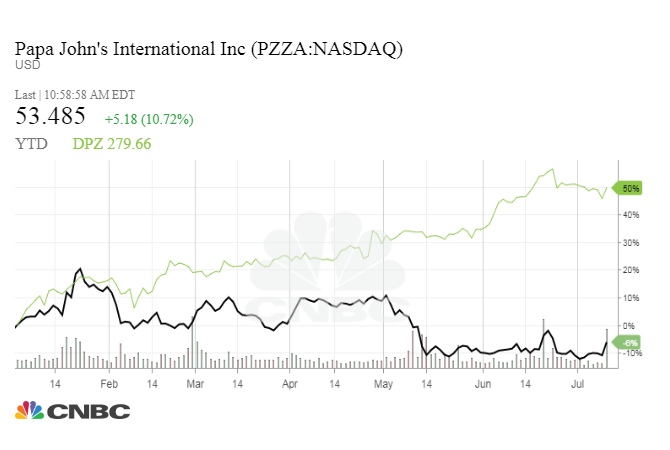
Papa John��s reputation with executives in the pizza industry has deteriorated after public backlash against its founder, John Schnatter, CNBC's Jim Cramer said Thursday.

"When you talk to high-level people in the pizza industry, there are people who think this company is falling apart," Cramer said on "Squawk on the Street."

Cramer spoke as the restaurant chain's stock was 11 percent higher midmorning Thursday after Schnatter resigned as chairman of the company's board.

The departure came shortly after Schnatter admitted to using the N-word during a May conference call and apologized for the comments after Forbes magazine detailed the incident.

Papa John��s business isn't in any immediate danger, according to Cramer, because he said pizza is still a strong growth category within the food and beverage industry.

"When you see the disparity between Papa John��s and Domino's, that's share take," Cramer, the host of CNBC's "Mad Money," said Thursday.

Papa John��s did not immediately respond to CNBC's request for comment.

With a market cap of $1.7 billion, Papa John��s has seen its stock fall more than 30 percent over the past year. Meanwhile, rival Domino's has seen its shares rise nearly 31 percent same over the same period.

Cramer recalled Schnatter, who founded the company in 1984, faced backlash in November for blaming the NFL and its leadership for the company's lackluster sales. That incident led to Schnatter resigning as CEO of the company.

Cramer said investors who buy Papa John��s should "hope there is an equity offering to clean up off of [Schnatter's] stuff."

Thursday, July 12, 2018

Which state ranks best overall for retirees?

There's�a lot to consider when selecting the best place to spend your�golden years. But have you considered going South?

South Dakota, that is.

A new report from�Bankrate.com�analyzed factors like�cost of living, tax�burden, weather, crime�and�health care quality�that people�must weigh when�determining a place to retire.

South Dakota came out on top with the best overall score. The landlocked state�that's home to Mount Rushmore placed first in well-being, second in taxes,�10th in cultural vitality and 12th in health care quality. Weather was the only category it didn't fare well in (38th).

��Yes, South Dakotans enjoy a low tax burden, but they are also more satisfied with their lives than anyone else," said�Taylor Tepper, an analyst at Bankrate.com.�

More Money: 3 reasons IRAs have edge over 401(k)s when it's time to tap your nest egg

More Money: Flexible hours, $10,000 referral fee: Small businesses get creative to hire in tight labor market

More Money: China's tariffs will hit farm states hard, spare service-heavy state

Faring the worst was�New York, landing�in the bottom 10 in�three categories: cost of living, taxes and health care quality. New Mexico and Maryland rounded out the bottom three states.

Traditionally popular retirement destination�Florida managed fifth place. It was dinged in scoring�for it's relatively high crime rate and poor health care rating.�Arizona (29th) and Nevada (42nd) did not score as well. The main culprits in Arizona��s case were low ratings for cultural vitality and crime. Nevada was dragged down by health care quality, well-being and crime.

Want to know where your retirement destination state ranked? Read on:

Best states to retire

1. South Dakota

2. Utah

3. Idaho

4. New Hampshire

Florida is extremely popular among retirees for its warm weather and low taxes. (Photo: An Lee, Shutterstock.com)

5. Florida

6. Montana

6.North Carolina

8. Wyoming

9. Nebraska

10. Mississippi

11. Hawaii

12. Massachusetts

13. Virginia

14. Michigan

Missouri ranked 15 on the list of best states to retire. (Photo: Thinkstock)

15. Missouri

16. Iowa

17. Colorado

18. Texas

19. Delaware

20. North Dakota

21. Tennessee�

22. Maine

23. Indiana

24. Alabama

25. Kansas

Burlington, Vermont (Photo: Getty Images/iStockphoto)

26. Vermont

27. Wisconsin

28. Minnesota

29. Arizona

30. Kentucky

31. Pennsylvania

32. New Jersey

33. West Virginia

34. Rhode Island

Hartford, Connecticut (Photo: Thinkstock)

35. Connecticut

36. Alaska

37. Georgia

38. Ohio

39. Oregon

40. Oklahoma

41. South Carolina

42. Nevada

43. Washington

44. Illinois

45. California

Little Rock, Arkansas (Photo: Thinkstock)

46. Arkansas

47. Louisiana

48. Maryland

49. New Mexico

50. New York

CLOSE

Trade your sunglasses for snowsuits and umbrellas if you want to live in one the three best cities for enjoying your golden years. Buzz60's Sean Dowling has more. Buzz60

Tuesday, July 10, 2018

Reviewing Medpace (MEDP) & Anavex Life Sciences (AVXL)

Medpace (NASDAQ: MEDP) and Anavex Life Sciences (NASDAQ:AVXL) are both small-cap medical companies, but which is the better investment? We will contrast the two businesses based on the strength of their institutional ownership, profitability, earnings, valuation, risk, dividends and analyst recommendations.

Analyst Recommendations

Get Medpace alerts:

This is a breakdown of recent ratings and recommmendations for Medpace and Anavex Life Sciences, as provided by MarketBeat.com.

Sell Ratings Hold Ratings Buy Ratings Strong Buy Ratings Rating Score
Medpace 0 7 1 0 2.13
Anavex Life Sciences 0 0 4 0 3.00

Medpace presently has a consensus target price of $37.40, indicating a potential downside of 15.67%. Anavex Life Sciences has a consensus target price of $7.50, indicating a potential upside of 129.36%. Given Anavex Life Sciences’ stronger consensus rating and higher possible upside, analysts plainly believe Anavex Life Sciences is more favorable than Medpace.

Earnings & Valuation

This table compares Medpace and Anavex Life Sciences’ revenue, earnings per share and valuation.

Gross Revenue Price/Sales Ratio Net Income Earnings Per Share Price/Earnings Ratio
Medpace $436.15 million 3.61 $39.12 million $1.52 29.18
Anavex Life Sciences N/A N/A -$13.46 million ($0.33) -9.91

Medpace has higher revenue and earnings than Anavex Life Sciences. Anavex Life Sciences is trading at a lower price-to-earnings ratio than Medpace, indicating that it is currently the more affordable of the two stocks.

Risk & Volatility

Medpace has a beta of 0.22, meaning that its stock price is 78% less volatile than the S&P 500. Comparatively, Anavex Life Sciences has a beta of 0.96, meaning that its stock price is 4% less volatile than the S&P 500.

Insider & Institutional Ownership

26.8% of Medpace shares are owned by institutional investors. Comparatively, 23.0% of Anavex Life Sciences shares are owned by institutional investors. 29.5% of Medpace shares are owned by insiders. Comparatively, 12.1% of Anavex Life Sciences shares are owned by insiders. Strong institutional ownership is an indication that hedge funds, large money managers and endowments believe a company is poised for long-term growth.

Profitability

This table compares Medpace and Anavex Life Sciences’ net margins, return on equity and return on assets.

Net Margins Return on Equity Return on Assets
Medpace 10.37% 12.50% 7.08%
Anavex Life Sciences N/A -73.46% -65.73%

Summary

Medpace beats Anavex Life Sciences on 9 of the 13 factors compared between the two stocks.

Medpace Company Profile

Medpace Holdings, Inc., a clinical contract research organization, provides scientifically-driven outsourced clinical development services to the biotechnology, pharmaceutical, and medical device industries worldwide. The company offers a suite of services supporting the clinical development process from Phase I to Phase IV in a range of therapeutic areas. Its clinical development services include medical affairs, clinical trial management, feasibility and start-up study, clinical monitoring, global regulatory affairs, medical writing, biometrics, pharmacovigilance, core laboratory, and quality assurance. Medpace Holdings, Inc. was founded in 1992 and is headquartered in Cincinnati, Ohio.

Anavex Life Sciences Company Profile

Anavex Life Sciences Corp., a clinical stage biopharmaceutical company, engages in the development of drug candidates for the treatment of Alzheimer's disease, other central nervous system diseases, pain, and various cancers. The company's lead drug candidates include ANAVEX 2-73, which has completed Phase IIa clinical trials for the treatment of Alzheimer's disease; and in preclinical clinical trials to treat Parkinson's disease, epilepsy, Rett syndrome, Angelman syndrome, multiple sclerosis, and Fragile X syndrome. Its preclinical drug candidates include ANAVEX 3-71 to treat Alzheimer's disease; ANAVEX 1-41, a sigma-1 agonist; ANAVEX 1037 for the treatment of prostate cancer; and ANAVEX 1066, a mixed sigma-1/sigma-2 ligand for the treatment of neuropathic and visceral pain. The company was founded in 2006 and is based in New York, New York.

Saturday, July 7, 2018

Gladius Token Market Cap Reaches $3.52 Million (GLA)

Gladius Token (CURRENCY:GLA) traded 6.1% higher against the US dollar during the 24 hour period ending at 23:00 PM E.T. on July 5th. One Gladius Token token can currently be bought for $0.25 or 0.00003846 BTC on exchanges including Kucoin and IDEX. Gladius Token has a total market capitalization of $3.52 million and $6,053.00 worth of Gladius Token was traded on exchanges in the last day. In the last week, Gladius Token has traded up 29.5% against the US dollar.

Here is how related cryptocurrencies have performed in the last day:

Get Gladius Token alerts: XRP (XRP) traded 3% lower against the dollar and now trades at $0.48 or 0.00007319 BTC. Stellar (XLM) traded 4.3% lower against the dollar and now trades at $0.20 or 0.00003111 BTC. IOTA (MIOTA) traded down 3.1% against the dollar and now trades at $1.16 or 0.00017721 BTC. Tether (USDT) traded up 0.5% against the dollar and now trades at $1.01 or 0.00015405 BTC. NEO (NEO) traded down 6.6% against the dollar and now trades at $39.57 or 0.00605064 BTC. TRON (TRX) traded down 4.3% against the dollar and now trades at $0.0376 or 0.00000575 BTC. Binance Coin (BNB) traded 0.5% higher against the dollar and now trades at $13.99 or 0.00213943 BTC. VeChain (VET) traded down 6.5% against the dollar and now trades at $2.53 or 0.00038758 BTC. Ontology (ONT) traded down 3.8% against the dollar and now trades at $4.97 or 0.00075956 BTC. Zilliqa (ZIL) traded down 7.1% against the dollar and now trades at $0.0839 or 0.00001283 BTC.

Gladius Token Profile

Gladius Token’s genesis date was October 29th, 2017. Gladius Token’s total supply is 16,825,229 tokens and its circulating supply is 13,990,246 tokens. The official message board for Gladius Token is medium.com/@gladiusio. Gladius Token’s official Twitter account is @gladiusio. The official website for Gladius Token is gladius.io.

Buying and Selling Gladius Token

Gladius Token can be bought or sold on these cryptocurrency exchanges: IDEX and Kucoin. It is usually not possible to buy alternative cryptocurrencies such as Gladius Token directly using U.S. dollars. Investors seeking to acquire Gladius Token should first buy Ethereum or Bitcoin using an exchange that deals in U.S. dollars such as Gemini, Changelly or GDAX. Investors can then use their newly-acquired Ethereum or Bitcoin to buy Gladius Token using one of the aforementioned exchanges.

new TradingView.widget({ “height”: 400, “width”: 650, “symbol”: “GLAUSD”, “interval”: “D”, “timezone”: “Etc/UTC”, “theme”: “White”, “style”: “1”, “locale”: “en”, “toolbar_bg”: “#f1f3f6”, “enable_publishing”: false, “hideideas”: true, “referral_id”: “2588”});

Thursday, July 5, 2018

Soligenix, Inc. Common Stock (SNGX) Stock Price Up 5.1%

Soligenix, Inc. Common Stock (NASDAQ:SNGX) shares rose 5.1% during mid-day trading on Tuesday . The stock traded as high as $1.07 and last traded at $1.03. Approximately 539,400 shares were traded during mid-day trading, an increase of 328% from the average daily volume of 126,172 shares. The stock had previously closed at $0.98.

SNGX has been the topic of several research analyst reports. HC Wainwright set a $3.00 price objective on Soligenix, Inc. Common Stock and gave the stock a “hold” rating in a research note on Friday, March 16th. Maxim Group set a $5.00 target price on Soligenix, Inc. Common Stock and gave the stock a “buy” rating in a report on Thursday, March 15th. Finally, ValuEngine upgraded Soligenix, Inc. Common Stock from a “strong sell” rating to a “sell” rating in a report on Wednesday, May 2nd.

Soligenix, Inc. Common Stock (NASDAQ:SNGX) last posted its earnings results on Friday, May 11th. The biopharmaceutical company reported ($0.27) earnings per share for the quarter, topping analysts’ consensus estimates of ($0.29) by $0.02. The company had revenue of $1.10 million during the quarter. Soligenix, Inc. Common Stock had a negative return on equity of 182.10% and a negative net margin of 149.71%. sell-side analysts anticipate that Soligenix, Inc. Common Stock will post -1.1 EPS for the current fiscal year.

About Soligenix, Inc. Common Stock

Soligenix, Inc, a late-stage biopharmaceutical company, focuses on developing and commercializing products to treat rare diseases in the United States. It operates in two segments, BioTherapeutics and Vaccines/BioDefense. The BioTherapeutics segment develops SGX301, a photodynamic therapy, which is in Phase III clinical trial to treat cutaneous T-cell lymphoma; and SGX942, an innate defense regulator technology that has completed Phase II clinical trial to treat oral mucositis in head and neck cancer.

Wednesday, July 4, 2018

Oppenheimer Upgrades Roku Stock -- Again

Every day, Wall Street analysts upgrade some stocks, downgrade others, and "initiate coverage" on a few more. But do these analysts even know what they're talking about? Today, we're taking one high-profile Wall Street pick and putting it under the microscope...

It's been about 3.5 months since Oppenheimer & Co., citing significant potential for improvement, relented on its underperform rating against Roku (NASDAQ:ROKU) stock and upgraded it to perform. Over that time frame, Roku shares have steadily appreciated from $34 in March to $43 a share today -- a 26% return in about 100 days.

Now, Oppenheimer upgrading Roku shares again -- this time to outperform.

Here's what you need to know.

The Roku Channel ad

Image source: Roku.

Recapping the March upgrade

To find out why, let's first take a quick look back at why Oppenheimer, which had believed Roku stock was too expensive,�changed its mind and upgraded Roku in March.

The reason for that upgrade can be summed up in three words: The Roku Channel (TRC). An app available on Roku over-the-top (OTT) boxes and television sets with Roku software built into them, TRC offers free movies to Roku users, and generates ad revenue for Roku itself. As CEO Anthony Wood explained in a conference call last year laying out his plans for TRC, "[C]onsumers want free content. Free is one of the top search terms on our website. ... The Roku Channel really addresses that."

What's more, because Roku owns the channel rather than hosting it as a third-party app created by someone else, with whom Roku would need to share revenue, TRC also produces better revenue and better profit margin for Roku. Combined with the company's "automatic content recognition" technology for generating data about which viewers are watching which commercials and when, it holds the potential to become even more profitable for Roku over time.

"I love it when a plan comes together"

So how is this thesis coming together for Oppenheimer so far? As you can guess from Roku stock's 26% gain since the March upgrade, pretty well -- and there's a reason for that.

As Oppenheimer advises today in its upgrade note, covered on StreetInsider.com�(subscription required), TRC now accounts for "0.63% of domestic time-spent on Roku's platform" and is attracting 9 million hours of viewing every month on average, making it Roku's "12th most-watched app by viewing hours." What's more, TRC has achieved this only nine months since launching, and it's logical to assume its success will only grow as more and more people come across the app and begin using it.

(Case in point: I own a Roku. I've never watched TRC. But now I'm starting to wonder what all the fuss is about and probably will.)

As Oppenheimer explains, it never "previously assumed [this level of adoption] was possible." Now that it sees it's not just possible, but actually happening, Oppenheimer is revisiting its earlier assumptions, gaining "incremental confidence" that TRC will "garner viewership on other platforms, such as Samsung, allowing Roku to monetize a broader portion of the OTT ecosystem," and recrunching its numbers.

Oppenheimer now estimates that Roku's "core platform" is worth $44 a share while the "off-platform Roku Channel opportunity" from revenue generated by placing TRC on TVs made by other companies is worth a further $7 a share.

The upshot for investors

There are two interesting things about these calculations, as I see them:

First, $44 plus $7 equals $51 a share in intrinsic value for Roku, which suggests there may be $1 more profit potential in Roku stock than even Oppenheimer's new $50 price target implies.

Second, while Oppenheimer assigns value to Roku's "core platform" (i.e., its advertising business, licensing its software, and basically everything "Roku" you see on a screen), it does not specifically assign any value to Roku's hardware business, which produces and sells actual Roku players.

On the one hand, that makes some sense because the player business is much less profitable (10% gross margin) than the platform business (75% gross margin). On the other hand, though, while data from S&P Global Market Intelligence confirms that Roku's player business isn't really growing its revenue anymore, it still accounted for $287 million in sales last year. That's more revenue than the platform business produced -- it's got to be worth something. And whatever it is worth would only add to the value of Roku stock as a whole.

Will all that value add up to Oppenheimer's posited $50 target price? Will it add up to an even higher share price than that? Until Roku turns profitable and begins generating some real free cash flow from its business, that's really hard to say. Still, analysts on average are predicting Roku will turn profitable next year, earning $0.02 per share -- then grow those profits 66 times in three years, earning as much as $1.32 per share in 2022.

Difficult as it may be for me, personally, to assign a value to a stock not currently earning profits, once Roku does turn profitable, I can see investors paying an awful lot of money to own a piece of that growth rate.